
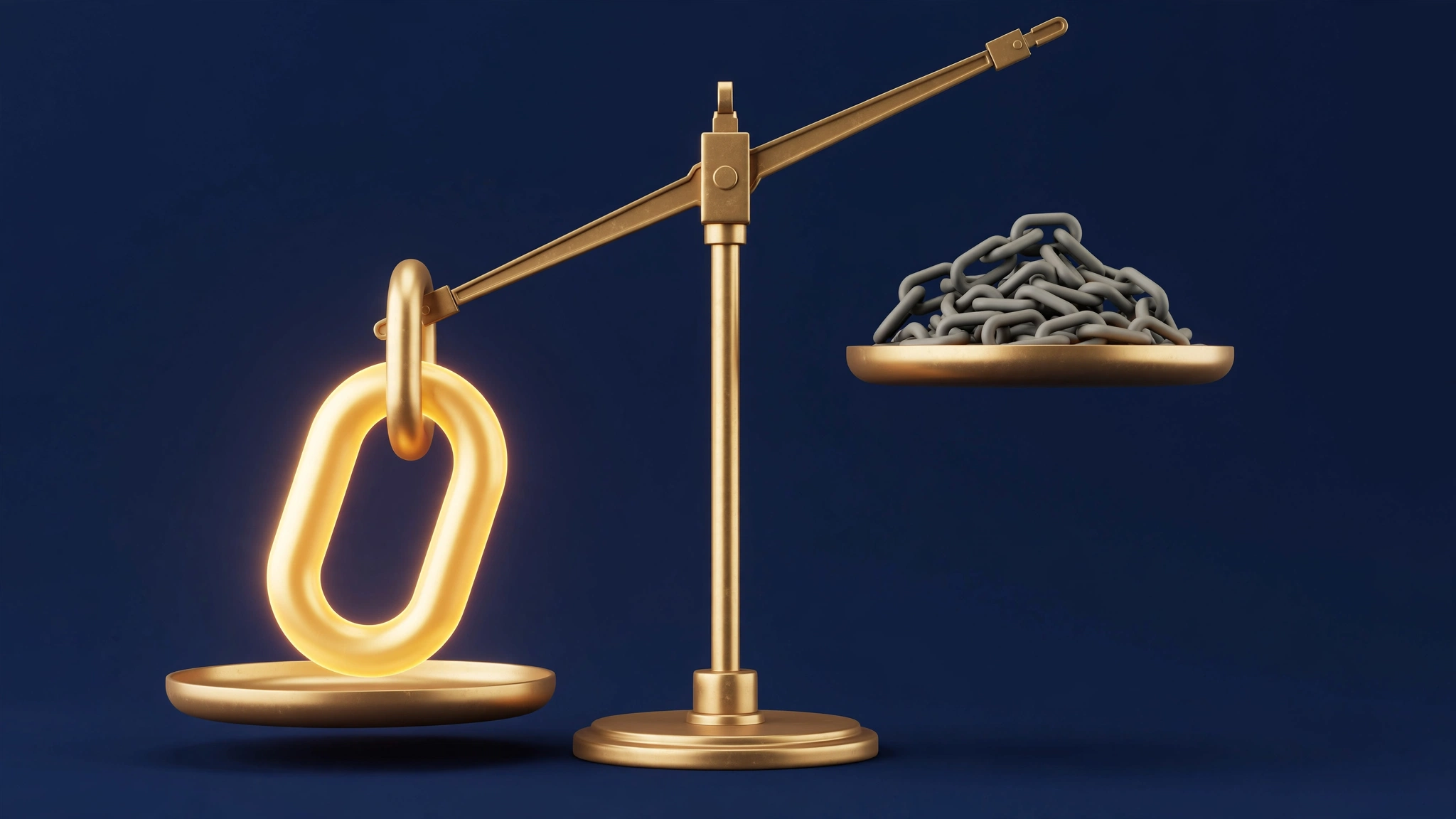
Yes — backlinks still matter in 2026, but less than in 2016. Google says links are no longer a top-three ranking factor, and their influence has shrunk. What remains: a handful of relevant, editorially earned links still separates ranking pages from stalled ones — especially in competitive SERPs.
On this page
- The Short Answer: Yes, but With Three Big Qualifiers
- What Google Actually Says About Backlinks
- Why Links Carry Less Weight Than They Used To
- What the Independent Data Still Shows
- Backlinks in the AI-Search Era
- When Backlinks Still Matter — and When They Don’t
- What Still Works in 2026
- The 2026 Verdict
- Frequently Asked Questions
If you are new to the concept, start with our explainer on the fundamentals of backlinks. This article is the verdict piece: what Google actually says, what the data shows, what stopped working, and what you should do about it in 2026.

The Short Answer: Yes, but With Three Big Qualifiers
The honest answer to “are backlinks still important” has three parts:
First, links count less than they used to. In 2016, a Google strategist named links as one of the top three ranking factors. By 2023, Google’s Gary Illyes said that was no longer true — and that it hadn’t been true “for some time.” Google’s documentation has quietly downgraded links too. So anyone selling you the old “links are everything” story is years out of date.
Large correlation studies keep finding the same pattern: stronger link profiles track with better rankings, most clearly on competitive keywords.
Third, the kind of link that counts has narrowed. Spammy, bought, and irrelevant links don’t just count less — Google mostly ignores them now. What counts is the editorial link: a real site, in your topic area, choosing to reference your page because it’s useful. That bar has only gone up.
So the 2026 verdict: backlinks are still important, but they’re a qualifier signal now, not a cheat code. They help Google choose between pages that are already good — they rarely rescue pages that aren’t.
What Google Actually Says About Backlinks
Here’s what Google’s own people have said, in order:
2016 — links are top three. Andrey Lipattsev, a Google search quality strategist, said links pointing at a site were one of the top three ranking factors, alongside content and RankBrain.
2023 — not top three anymore. At Pubcon Pro in Austin, Google’s Gary Illyes was asked whether links were still among the three most important ranking factors. His answer: “I think they are important, but I think people overestimate the importance of links. I don’t agree it’s in the top three. It hasn’t been for some time.” (via Search Engine Land). He added that it is possible to rank without links — and mentioned an edge case of a site with zero links ranking number one consistently, discovered only through its sitemap.
March 2024 — the documentation downgrade. Alongside the March 2024 core update, Google edited its spam policies documentation. The old wording said “Google uses links as an important factor in determining the relevancy of web pages.” The new wording simply says “Google uses links as a factor in determining the relevancy of web pages.” The word “important” was quietly removed. (via Search Engine Journal)
April 2024 — “very few links.” The same month, John Mueller advised that “there are more important things for websites nowadays, and over-focusing on links will often result in you wasting your time doing things that don’t make your website better overall.” Days later, Illyes said publicly that Google needs “very few links” to rank pages.
Google’s message is consistent: links still matter, but they are now one signal among many — and obsessing over them is, in Google’s own words, often a waste of time.
Why Links Carry Less Weight Than They Used To
Google didn’t demote links on a whim. Three forces pushed them down:
Google got better at understanding content directly. When search relied on PageRank, links were the main way Google judged a page’s worth. Systems like BERT and MUM changed that — Google can now evaluate what a page says and whether it matches the query without needing links to tell it the page is trustworthy. Language understanding took over part of the job links used to do.
Spam detection caught up with manipulation. For years, Google fought link spam with penalties. Modern systems mostly do something quieter: they devalue manipulative links instead of punishing them. A bought link on an irrelevant site usually just counts for nothing now — which is also why the disavow tool matters less than it used to for most sites.
The algorithm has many more signals now. Content quality, intent match, user engagement, page experience, topical authority — the ranking equation has far more terms than it did in 2014, and links are a smaller slice of a bigger pie.
None of this means links are dead. It means the cheap, scalable link tactics are dead — and they have been for a while. What survived is the part that was always legitimate: genuine editorial references.
What the Independent Data Still Shows
Google’s statements are one side of the story. Independent studies are the other — and they mostly agree: links matter less than they did, and they still matter. The key numbers, all attributed:
- Backlinko’s analysis of 11.8 million Google results found the number-one result had, on average, 3.8x more backlinks than positions 2 through 10. Caveat: that study is from 2016 and has never been re-run, so treat it as directional, not current.
- Ahrefs’ study of 1 million US keywords found referring domains correlated with rankings at 0.255 — the strongest of the link metrics they tested — ahead of raw backlinks (0.248) and Domain Rating (0.131). For local-intent queries the correlation was higher, at 0.33. (via userp.io’s link-building statistics compendium)
- The trend is downward, not dead. Ahrefs’ referring-domain correlation fell from 0.29 in its 2019 study to roughly 0.22–0.24 in 2024. Links matter less than they did — and they still matter.
- Semrush’s 28,000-domain study found 92.3% of domains ranked in the top 100 for all 13 months had at least one backlink, while 55.1% of new domains that never reached the top 10 had none.
- A 2026 survey of 131 SEO experts (the Zyppy Signal survey, reported by Links.me) scored “links from highly trusted domains” at +2.47 and “links from topically relevant pages” at +2.22 — among the highest scores in the entire survey. Raw “total number of links” scored just +1.05, and spammy backlinks scored −1.26. Relevance and trust beat volume by a wide margin.
- Practitioners still bet on links. In the same data set, 67.5% of SEOs said backlinks have a big impact on rankings, 30% said moderate, and only 2.5% said low.
Remember: these are correlations, not proof of causation. Strong pages earn links because they’re strong. But across studies, years, and data sets, the overlap between link authority and visibility is too consistent to dismiss.
Here’s the scoreboard view of what still counts in 2026:
| Signal | Status in 2026 | Why |
|---|---|---|
| Editorial links from trusted, topically relevant sites | Still counts — most | Strongest correlation in every modern study; hardest to fake |
| Brand mentions on authoritative sites | Growing | Google’s quality guidelines treat off-site reputation as a trust signal, with or without a link |
| Unique referring domains (diversity) | Still counts | Ahrefs data shows referring domains beat raw link counts |
| Nofollow / sponsored links | Counts a little | Experts rate them slightly positive; referral and brand value remain |
| Raw link volume from irrelevant sites | Mostly ignored | Devalued, not penalized — wasted effort |
| Paid links, PBNs, link schemes | Risky, zero upside | Google ignores most; the rest can trigger manual action |
Backlinks in the AI-Search Era
The newest chapter of this debate is AI search — Google’s AI Overviews, AI Mode, and assistants like ChatGPT that answer questions directly. Two things are happening at once.
Google says AI Overviews help users discover content across the web, and they link out to source pages. When a generated answer needs to pick which pages to cite, the same trust signals that power classic rankings — including who links to you — help decide.
Citability is becoming the currency. There is an emerging pattern, reported by practitioners, of strong editorial mentions boosting visibility in AI answers specifically. One SEO consultant, Andrew Shotland, described a client whose visibility in ChatGPT rose roughly fourfold in the week after a mention and link in a Reuters article. That’s a single anecdote, not a study — but it fits the logic: AI systems are trained to weight authoritative, widely referenced sources, and backlinks remain one of the clearest signals of that authority.
Brand mentions matter more than ever. Google’s quality rater guidelines treat off-site reputation — backlinks, brand mentions, third-party citations — as a primary way to verify authoritativeness. In AI search, where answers synthesize from many sources, being mentioned across trusted publications may carry weight even when no link follows. We cover this shift in detail in our guide to brand mentions vs backlinks in AI search.
The takeaway: AI search didn’t kill links. If anything, it made the trust layer behind them more important — because a machine deciding what to cite needs trust signals even more than a human scanning ten blue links.
When Backlinks Still Matter — and When They Don’t
Use this diagnostic before spending time or money on link building:
| Your situation | Are links the answer? | Do this first |
|---|---|---|
| Page isn’t indexed at all | No | Fix technical SEO — sitemaps, crawlability, internal linking |
| Indexed but ranking nowhere, content is thin | No | Rewrite for intent; links can’t save weak content |
| Good content stuck on page 2–3 behind stronger domains | Yes — prime case | Earn a few relevant referring domains to the page |
| Competing for commercial keywords against big brands | Yes | Link authority is often the tiebreaker here |
| Low-competition niche, thin SERPs | Probably not | Publish and let topical coverage do the work |
| New site, zero referring domains | Eventually | Content first; start earning links once you have something worth citing |
The pattern: links are an amplifier, not a foundation. Fix the page first — links are the lever that moves an already-good page.
Bookmark this diagnostic and revisit it quarterly — your situation changes as your site grows. What starts as a content problem often becomes a link problem once the content is fixed, and recognizing that shift early is what separates sites that break through from sites that stall.
What Still Works in 2026
If you’re going to invest in links, invest in the kind Google still rewards. The playbook has narrowed to a few approaches:
Earn editorial links, don’t manufacture them. The link that counts is one an editor placed because your page improved their content. That happens when you publish things worth citing: original data, genuinely useful tools, clear explainers, expert quotes. Outreach still works when it’s targeted and the asset is real — see our guide on earning backlinks the legitimate way.
Digital PR beats directory blasts. Original research and newsworthy angles earn links from publications with real audiences — and a journalist’s link is editorial by definition.
Keep anchors natural. Anchor text still helps Google understand a page’s topic, but the old exact-match game is over. Keep profiles mostly branded anchors, naked URLs, and descriptive partial matches — over-optimization makes good links look manufactured.
Prioritize relevance over metrics. A link from a respected site in your niche, with real traffic and a real audience, typically outperforms a high-metric link from an unrelated site. When vetting any opportunity, ask one question: would this link still make sense if Google ignored it completely? If real readers would click it, it’s usually worth pursuing.
And know what to avoid:
| Green flags | Red flags |
|---|---|
| Topically relevant site with real traffic | Unrelated site with a “write for us” page |
| Link inside the article body, placed by an editor | Footer, sidebar, or sitewide template links |
| Natural, varied anchor text | Repeated exact-match commercial anchors |
| Site links out selectively | Every post stuffed with outbound links to random niches |
| Page exists for readers, link is a bonus | Page exists only to host links |
If your profile already has bought placements, spammy directories, or obvious PBN footprints, audit them against our guide to identifying toxic backlinks. Google ignores most junk automatically, but a manual review is still worth it for anything you built or paid for.
The 2026 Verdict
Backlinks are still important — just not in the way the old SEO playbook taught. They are no longer a top-three ranking factor, and they will not carry a weak page. But in competitive SERPs, and increasingly in AI-generated answers, they remain one of the clearest trust signals available. No one has invented a better one yet.
If you take three actions from this article:
- Stop chasing volume. Ten earned, relevant links beat a hundred manufactured ones — and the manufactured ones mostly get ignored now.
- Fix the page before the profile. Intent match, depth, and technical health come first. Links amplify; they don’t create.
- Build citability, not just links. Publish things worth referencing. Mentions, citations, and editorial links are converging into one trust signal — and AI search is only accelerating that.
The sites winning in 2026 aren’t the ones with the most links. They’re the ones other sites can’t help but reference. For the how-to behind that, our white-hat link building guide covers the tactics that still earn those references.
Frequently Asked Questions
Do backlinks still matter for Google rankings in 2026?
Yes, but less than they used to. Google has said links are no longer among the top three ranking factors, yet independent studies — from Ahrefs’ keyword correlations to a 2026 survey of 131 SEO experts — consistently find that pages with stronger, more relevant link profiles rank better, especially for competitive keywords.
Can you rank without backlinks?
Sometimes. Google’s Gary Illyes has said it’s possible, citing a site with zero links that ranked number one on content strength alone. In practice, that’s the exception: it tends to work for low-competition queries on sites that already have trust. For competitive keywords, ranking without any external links is rare.
Are backlinks less important than content now?
For most pages, yes — content and intent match come first. Backlinks act as a tiebreaker between pages that are already good. A strong link profile rarely saves weak content, but it frequently decides which of several strong pages ranks highest.
Do backlinks help you appear in AI search results?
Indirectly, yes. AI Overviews and assistants like ChatGPT favor authoritative, widely cited sources, and backlinks remain one of the clearest signals of that authority. Early practitioner reports suggest strong editorial mentions can lift AI visibility too, though the data here is still anecdotal rather than settled.
Should I still build backlinks in 2026?
Build the right ones, at the right time. If your pages are technically sound and match search intent but stall behind stronger domains, earning relevant editorial links is still one of the highest-leverage things you can do. If your content isn’t there yet, invest in the content first — links are an amplifier, not a foundation.
Done-for-you podcast backlinks
Get your brand on Apple Podcasts, Spotify, Amazon and 25 more trusted platforms — placed by hand, reported link by link.