
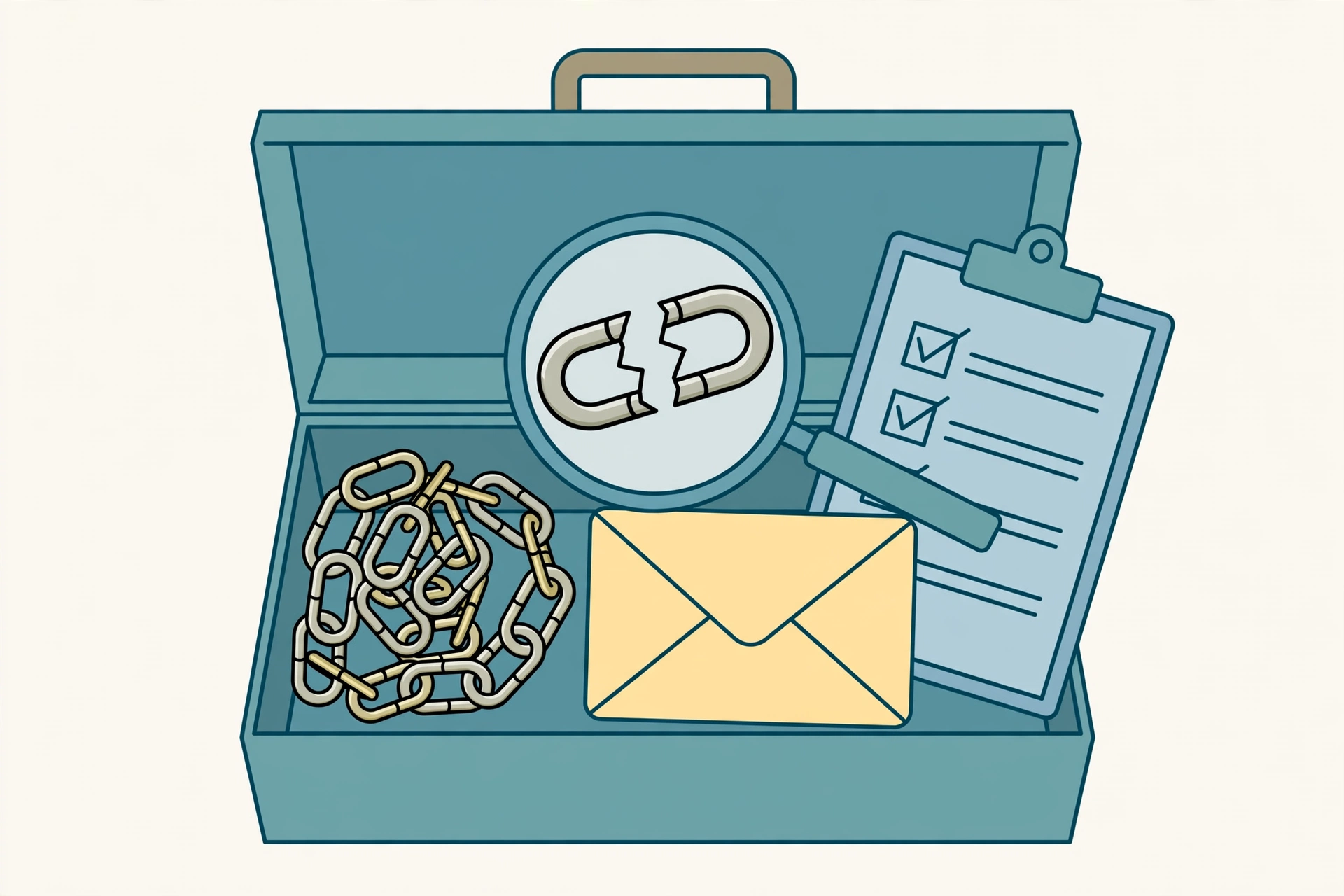
Link building has a reputation for being expensive — paid databases, pricey outreach platforms, agency retainers in the thousands. But the best free link building tools can carry you surprisingly far. You don’t need a paid subscription to find prospects, check authority, or run outreach. You need a system that connects the right free tools in the right order.
On this page
This guide does two things. First, it covers the free tools worth using in each link building category: backlink checkers, broken link checkers, prospecting, and outreach. Second — and this is the part most “free tools” listicles skip — it gives you the complete $0 link building workflow: a step-by-step process that uses only free tools to find prospects, vet them, find contacts, and pitch them. It also answers the uncomfortable question honestly: why there is no such thing as a free done-for-you link building service.
Can You Really Build Links for Free?
Yes — with one important caveat. The tools can cost you nothing. Your time will not. Link building is relationship work: finding the right sites, qualifying them, writing pitches that actually get answered. Free tools give you the data and the delivery mechanism; the judgment and the writing still come from you.
That trade-off is actually an advantage when you’re starting out. Working with free tools forces you to learn the fundamentals — how to evaluate a prospect, what makes a pitch worth answering, how to track a campaign — instead of hiding behind a dashboard. People who start on paid suites often automate a broken process. People who start free usually build a process worth automating later.
What you cannot do for free is outsource the thinking. Anyone promising “free link building services” — a company that builds your links for nothing — is either running a trial that converts into a paid plan, or running a link scheme you don’t want near your site. (There’s a full section on that below.) Real free link building means DIY: you do the work, the tools cost zero.

Free Backlink Checker Tools
Every link building campaign starts with qualification. Before you pitch a site, you need to know whether a link from it is actually worth earning. Free backlink checkers answer that question: they show you a domain’s authority metrics, how many sites link to it, and what its link profile looks like.
MSF Website Authority Checker is the natural starting point. It’s free, requires no signup, and gives you authority metrics for any domain — exactly what you need when you’re vetting a prospect list. Run every prospect through it before you spend a minute writing a pitch. If the authority is near zero, the site has no traffic, and the backlink profile looks empty, move on.
Google Search Console is the other essential free checker — for your own site. Its Links report shows which sites already link to you, which pages attract the most links, and your most common anchor text. This is free, first-party data straight from Google, and it’s the foundation of any link reclamation work you do (finding unlinked mentions and lost links worth reclaiming).
Beyond those two, the free tiers of paid platforms give you limited but real data. Moz Link Explorer offers a handful of free queries with Domain Authority scores. Semrush and Ahrefs both have limited free accounts that show a sample of any domain’s backlinks. The query limits are real — you might get 10 searches a day — so save them for prospects that survived your first free-tool pass.
For the full comparison of no-cost checkers, see our guide to free backlink analysis suites — it goes deeper into each option’s query limits so you can plan your usage around them.
Free Broken Link Checker Tools
The broken link building method is arguably the highest-ROI strategy available to a $0-budget link builder: you find dead links on other people’s resource pages, create (or point to) content that replaces them, and get an editorial link for helping the webmaster. The entry ticket is a broken link checker, and the good news is the best ones are free.
Check My Links is a free Chrome extension that scans any page you visit and highlights broken links. It’s the fastest way to check a resource page before you pitch: load the page, click the extension, and within seconds you know every dead link on it. Zero cost, zero signup.
Dr. Link Check offers a free tier that crawls up to a set number of links per month — useful when you want to scan a prospect’s whole site rather than a single page. Ahrefs’ free broken link checker lets you enter any URL and see its broken outbound links without an account, which is perfect for vetting individual resource pages.
The workflow is simple: use Google search operators (covered in the prospecting section) to find resource pages in your niche, run them through a broken link checker, and pitch replacements for the dead links you find. For the full directory of free options and their limits, see our broken link checker tools guide.
Free Prospecting Tools
Prospecting — finding sites worth pitching — is the stage most beginners overcomplicate. In practice, roughly 80% of free prospecting is just Google search operators, and they never expire, never rate-limit you, and never cost a cent.
Learn these queries and you’ll never run out of prospects:
your keyword + intitle:resources— finds resource pages linking out to useful contentyour keyword + “write for us”— finds blogs actively accepting guest postsyour keyword + “helpful links”or“useful links”— more resource-page variantsyour keyword + inurl:links— pages with “links” in the URL, often link directories and resource listssite:competitor.comcombined with the above — find where competitors’ content gets linked
Google Search Console contributes here too: the “Top linking sites” report shows who’s already linking to you. Sites linking to you are warm prospects for more links, and sites in the same niche linking to competitors (which you can partially see through free checker samples) become your outreach list.
For contact finding, Hunter.io’s free tier gives you 25 searches per month — enough to find email addresses for a small campaign. Snov.io offers a similar free tier. The limit sounds small, but here’s the thing: if you’re sending more than 25 pitches a month as a beginner, your pitch quality is almost certainly suffering. Twenty-five well-researched, personalized emails will outperform two hundred templated ones.
The honest reality of free prospecting: it’s slow. A paid database builds a 500-prospect list in an afternoon; free operators build it in a week. But the prospects you find manually tend to be higher quality, because the work itself filters for relevance — and you’ll actually know why each site is on your list, which makes your pitches dramatically better.
Free Outreach Tools
Once you have a vetted prospect list and contact emails, you need to send pitches, follow up, and track replies. Under about 50 prospects a month, the free stack genuinely beats paid platforms — not just on price, but on quality, because it keeps you writing every email yourself.
Gmail is your sending tool. There’s no deliverability advantage to an outreach platform at low volume; a real email from a real person, sent from a normal inbox, is exactly what you want. Send in small batches, personalize each one, and never blast.
Streak is a free CRM that lives inside Gmail. It adds pipelines to your inbox so you can track every prospect through stages — contacted, replied, follow-up sent, link live — without leaving your email. For a solo link builder, this replaces a spreadsheet and keeps nothing slipping through the cracks.
Hunter.io’s free tier (25 searches/month) handles contact finding, and a simple spreadsheet template handles what Streak doesn’t: logging the prospect’s URL, the broken link or angle you pitched, the date sent, and the follow-up date. Set a rule: follow up once, seven days later, politely, and then move on. Most link building replies come from the follow-up, not the first email.
The temptation is to buy an outreach automation tool early. Resist it. Automation multiplies your baseline — if your manual emails earn a 5% reply rate, automation gives you 5% at scale. Fix the pitch first (our link building outreach guide covers the craft), then automate the sending once your prospect lists genuinely exceed what you can handle by hand.
Free SEO Tools Worth Having
Beyond the core link building stack, a few free SEO tools make your campaigns measurably better. Only tools that serve the link-building workflow belong here — not a generic free-SEO dump.
A keyword volume checker keeps your content targeting real demand. There’s no point earning links to a page nobody searches for; check that your target keyword has actual monthly volume before you invest weeks pitching for it. MSF’s own keyword volume checker handles this for free.
Google Search Console (again) is your results dashboard: watch which pages gain links and rankings as your campaign runs, and catch any toxic links early. PageSpeed Insights matters too — nobody links to a page that takes eight seconds to load, and webmasters are more likely to accept your replacement link if your page is fast and clean.
Schema validators (Google’s Rich Results Test) ensure your pages are eligible for rich results — a small thing, but when a webmaster compares your replacement content against a competitor’s, every detail of quality counts.
“Free Link Building Services” — The Honest Truth
Every month, people search for “free link building services” hoping someone will build their links for nothing. Let’s be direct: there is no real free done-for-you link building service. Link building takes human hours — research, writing, relationship management — and nobody does skilled human hours for free at scale.
So what do the “free” offers actually turn out to be? Usually one of three things. Free trials of paid services — legitimate, but the free part ends quickly by design. Link schemes dressed up as free: directories, blog networks, and automated placements that cost you nothing upfront and cost you a penalty later. Or scams: services that take your “free trial” signup, harvest your site’s credentials or data, and disappear.
Google’s spam policies are explicit that manipulative link schemes — including large-scale link exchanges and automated link creation — can trigger manual actions. A “free” service building hundreds of links to your site is either doing nothing (best case) or doing something Google explicitly penalizes (worst case). Neither outcome helps you.
The real free alternative is the DIY workflow below. It’s the only free option that actually works, because it’s the only one where someone — you — is doing the quality work. If your time is genuinely worth more than the hours link building takes, then pay a reputable service. But “free” service as a category doesn’t exist. Now you know.
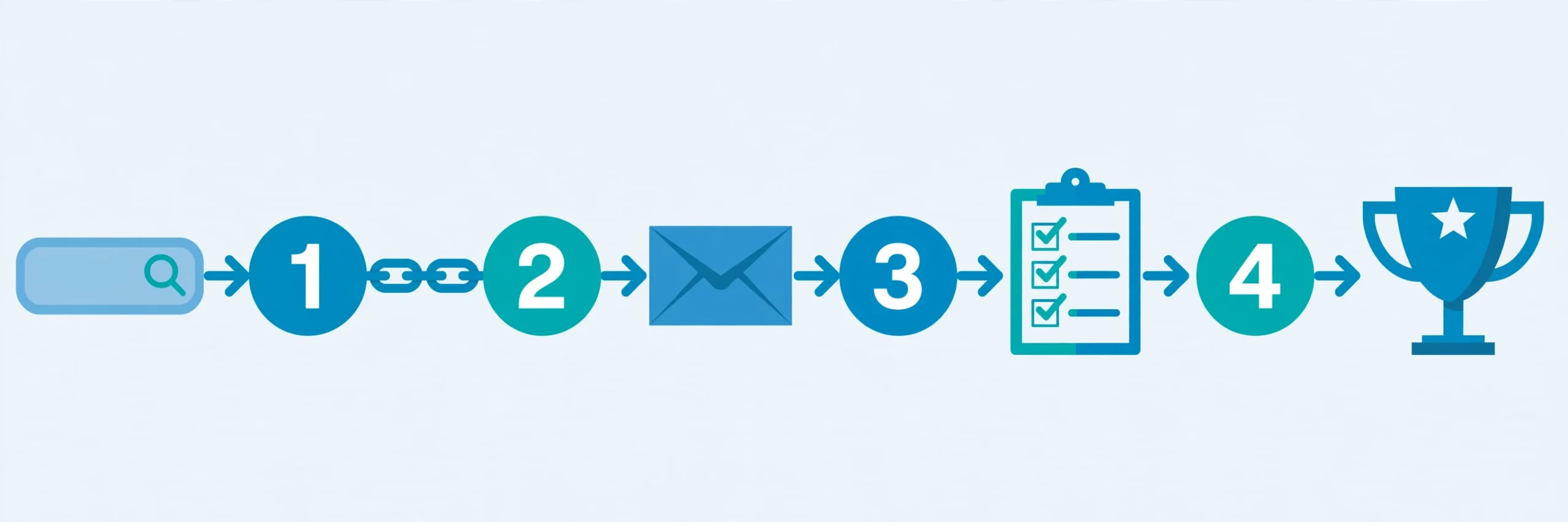
The $0 Link Building Workflow
Here’s the complete system, using only the free tools covered above. It runs in a loop — prospects in, pitches out, links earned, repeat.
Step 1 — Find prospects (week 1). Run Google search operators for resource pages and guest post targets in your niche. Aim for 30–50 prospects. Log each in your spreadsheet: site name, URL, why it’s relevant, and the specific page you’d pitch to.
Step 2 — Vet every prospect (week 1). Run each domain through the MSF Website Authority Checker. Cut anything with near-zero authority, no real traffic, or an obviously spammy link profile. Expect to cut a third of your list — that’s the vetting working, not failing. Then scan the surviving resource pages with Check My Links to find broken links you can replace.
Step 3 — Find contacts (week 2). Use Hunter.io’s free tier to find email addresses for your vetted prospects — 25 searches a month means you’ll prioritize the best 25 and find the rest manually (contact pages, author bios, and LinkedIn work fine). Quality over quantity: 25 excellent pitches beat 100 mediocre ones.
Step 4 — Pitch (weeks 2–3). Send personalized emails from Gmail, tracked in Streak. Each pitch references something specific: the broken link you found, the resource page section you’d fit, the guest post idea tailored to their audience. One follow-up after seven days. Then stop — persistence is good, pestering is not.
Step 5 — Track and repeat (ongoing). Log every outcome in your spreadsheet: sent, replied, link live, no response. After your first 25-pitch cycle, review what worked. Which subject lines got opens? Which angles got replies? Double down on what worked for cycle two. Check Search Console monthly to watch new links appear.
Knowing When Free Stops Being Enough
Free tools have real ceilings, and it’s worth knowing where they are so you recognize them instead of blaming your process. Hunter’s 25 monthly searches become a bottleneck the moment your prospect lists grow past small campaigns. Manual prospecting eats hours that a paid database would compress into minutes. Free checker query limits mean you can’t run bulk competitor analysis.
When budget appears, buy in this order. First, one seat of Ahrefs or Semrush — a single paid seat beats five small tools because it removes the prospecting and analysis bottlenecks at once. Second, an outreach platform like BuzzStream or Pitchbox — but only when your prospect volume genuinely exceeds what Gmail + Streak can handle. Third, a dedicated email finder with higher limits.
Until then, the free stack is not a handicap. It’s the foundation. Every skill you build on $0 — qualifying prospects, writing pitches, tracking campaigns — transfers directly to the paid tools when you eventually buy them. Start free, learn the craft, and spend money only on your actual bottleneck.
Done-for-you podcast backlinks
Get your brand on Apple Podcasts, Spotify, Amazon and 25 more trusted platforms — placed by hand, reported link by link.