

To increase Trust Flow, earn backlinks from websites that are themselves trusted by Majestic’s seed sites — relevant, authoritative domains in your niche. Audit your existing link profile, disavow spammy links, and create content worth citing. Trust Flow rises when quality sources vouch for you, not when link volume grows.
On this page
Domain authority gets most of the attention, but experienced SEOs watch another metric just as closely: Trust Flow. Developed by Majestic, Trust Flow measures the quality of your backlink profile on a 0–100 scale — not how many links you have, but how trustworthy the sites linking to you are.
This guide explains exactly how Trust Flow works, why the ratio between Trust Flow and Citation Flow matters more than either number alone, and the specific strategies that move the needle.
What Is Trust Flow?
Trust Flow is a link-quality metric created by Majestic, one of the oldest backlink index providers in SEO. It scores a website from 0 to 100 based on the trustworthiness of the sites linking to it.
The key idea: Majestic starts with a manually curated set of “seed” websites — highly trusted domains like major news outlets, universities, and government sites. Trust then flows outward through links. A site linked directly by a seed site earns high Trust Flow. A site five link-hops away from any seed site earns very little.
This is fundamentally different from raw link counts. Majestic’s methodology is deliberately conservative: rather than trusting every link equally, it anchors the entire web of trust to domains that humans have verified as legitimate. That human-curated starting point is what makes Trust Flow harder to manipulate than purely algorithmic metrics — you cannot fake proximity to a seed site with volume alone.
Consider two websites:
- Site A has 10,000 backlinks, mostly from directories, forums, and low-quality blogs. Its Trust Flow is 8.
- Site B has 300 backlinks, but several come from respected industry publications and a university research page. Its Trust Flow is 42.
Site B will almost always outperform Site A in competitive search results, despite having only a tiny fraction of the link volume. Search engines have used trust-based signals since Google’s original PageRank research — a link is a vote, but votes from trusted sources count far more.
Trust Flow vs Citation Flow: Understanding the Ratio
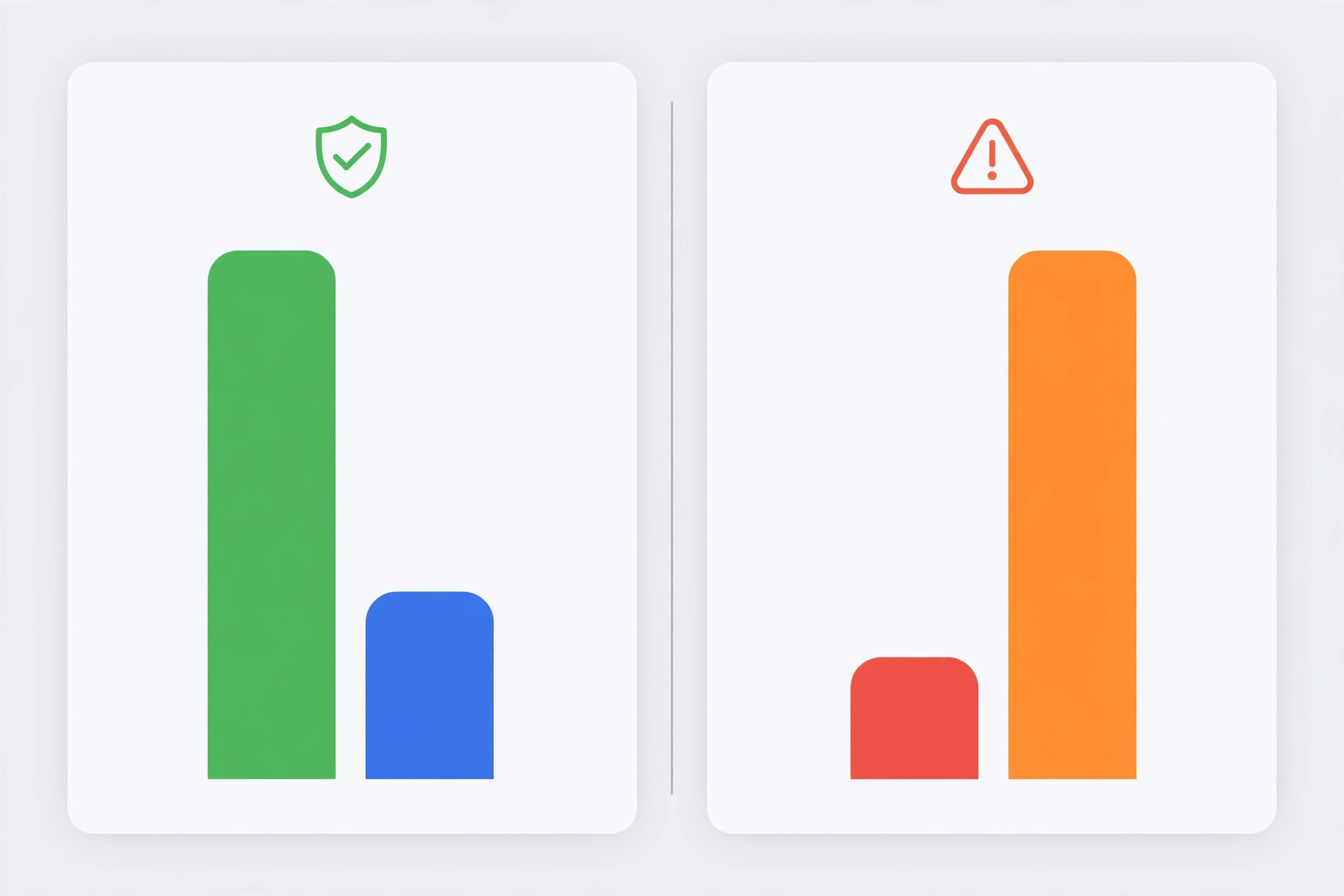
Majestic pairs Trust Flow with a sibling metric called Citation Flow, which measures link quantity — roughly, how much “link equity” flows to a site regardless of source quality. The relationship between the two tells you more than either number alone.
| TF / CF Pattern | What It Means | Typical Cause |
|---|---|---|
| High TF, High CF | Strong, trusted, popular site | Years of earning quality links at scale |
| High TF, Low CF | Trusted but small footprint | Niche authority site with few but excellent links |
| Low TF, High CF | Loud but untrusted — red flag | Link spam, directories, paid link schemes |
| Low TF, Low CF | New or invisible site | Brand-new domain, no link building yet |
The dangerous pattern is low Trust Flow with high Citation Flow. It signals that a site has accumulated many links that search engines don’t trust — the classic footprint of manipulative link building. Sites with this imbalance are often the first to lose traffic during Google core updates.
A healthy rule of thumb: your Trust Flow should be at least half your Citation Flow. If your CF is 40 and your TF is 12, you have a trust deficit to fix before building more links.
It’s worth noting that both metrics are logarithmic, not linear — moving from TF 10 to TF 20 requires far less effort than moving from TF 40 to TF 50. Early gains come quickly once you clean up obvious spam; later gains demand genuinely authoritative endorsements. Set expectations accordingly: doubling a low score in a few months is realistic, but pushing past 40 in a competitive niche is a multi-year project.
How to Increase Trust Flow
Increasing Trust Flow comes down to one principle: earn links from sites that Majestic already trusts, and remove or disavow links from sites it doesn’t. Here are the strategies that actually work, ordered by impact.
Earn Links From High-Trust, Relevant Domains
A single backlink from a website with Trust Flow 60+ in your niche moves your score more than fifty links from TF 10 blogs. Identify the most trusted sites in your industry — trade publications, professional associations, established news outlets — and earn coverage there.
Practical ways to do this include original research that journalists cite, expert commentary for reporters, and genuinely useful free resources. Digital PR campaigns are particularly effective because news domains typically carry very high Trust Flow.
Audit and Clean Your Existing Link Profile
Before building new links, stop the bleeding. Use Majestic’s own backlink index (or Ahrefs) to export your referring domains, then look for the patterns that drag Trust Flow down: foreign-language sites with no relevance to your content, obvious link farms, hacked or deindexed domains, and sitewide footer links from unrelated sites.
For links you can’t get removed, use Google’s Disavow tool to tell search engines to ignore them. This won’t directly change your Majestic Trust Flow overnight — Majestic recrawls on its own schedule — but it protects your Google rankings while your trust profile improves. Our guide on toxic backlinks walks through identifying the worst offenders.
Create Content That Trusted Sites Want to Cite
High-trust websites link to content that makes them look good for referencing: original data, definitive guides, and unique analysis. A generic “ultimate guide” rarely earns links from authoritative domains — but a well-designed study with fresh numbers does.
You don’t need a research budget. Analyze public data in a new way, survey your own audience, or compile the most thorough comparison in your niche. When experts cite your work, their trust flows to you.
Use Guest Posting Selectively on Authority Sites
Guest posting still works for Trust Flow — if you’re selective. One guest article on a respected industry publication with genuine editorial standards beats ten posts on generic “write for us” blogs. Check a prospect’s own Trust Flow in Majestic before pitching; if their TF is below 20, the link won’t help yours much.
Build Topical Relevance, Not Just Raw Authority
Majestic also reports Topical Trust Flow — your trust score broken down by category (Business, Computers, Health, and so on). A link from a high-trust site in an unrelated category passes less topical trust than a link from a moderately trusted site in your own category.
If you run a plumbing business, a link from a respected home-improvement publication helps your Topical Trust Flow far more than a link from a high-authority cooking blog. Pursue relevance first, raw authority second.
Fix Technical Issues That Block Trust Signals
Trust can’t flow through broken pipes. Make sure your most linked-to pages return 200 status codes (not redirects or 404s), that your site loads reliably, and that you haven’t accidentally nofollowed your own internal links to key pages. A strong overall domain profile amplifies every trust signal you earn.
Topical Trust Flow and Why Relevance Matters

Many SEOs check their headline Trust Flow number and stop there. The more useful view is Topical Trust Flow, which shows where your trust comes from. Majestic categorizes every linking domain, so you can see whether your trust is concentrated in your actual niche or scattered across unrelated topics.
Why does this matter? Because Google’s understanding of authority is increasingly topical. A site with TF 35 concentrated in “Business/Marketing” will outrank a site with TF 35 spread thinly across fifteen unrelated categories — for marketing keywords, at least.
To build topical trust deliberately:
- Prioritize outreach to publications inside your category, even if their headline TF is slightly lower than an unrelated alternative.
- Create content clusters around your core topics so that relevant sites have a natural reason to link to multiple pages.
- Monitor your Topical Trust Flow quarterly; if an unrelated category starts dominating, rebalance your link building toward your niche.
Mistakes That Lower Your Trust Flow
Trust Flow is easier to lose than to gain. These are the most common ways sites damage theirs:
- Buying links in bulk. Paid link packages almost always come from low-trust networks. Each one dilutes your ratio further.
- Reciprocal link schemes. “You link me, I link you” arrangements at scale are easy for crawlers to detect and carry zero trust.
- Ignoring your backlink profile for years. Spammy links accumulate naturally over time — scrapers, negative SEO, old directories. Without regular audits, they quietly drag your score down.
- Chasing Citation Flow instead of Trust Flow. Any tactic optimized purely for link volume (automated submissions, mass directory listings) raises CF while TF stays flat — the exact imbalance search engines penalize.
- Sitewide footer and sidebar links. Hundreds of links from one unrelated domain look manipulative and pass minimal trust.
The pattern is consistent: shortcuts that inflate link counts without earning genuine editorial trust always show up in the TF/CF ratio eventually.
Frequently Asked Questions About Trust Flow
What is Trust Flow in SEO?
Trust Flow is a 0–100 metric by Majestic that measures the quality of a website’s backlinks. It’s calculated based on how closely a site is linked to a set of manually curated, highly trusted “seed” websites. Higher scores mean more trustworthy link sources.
What is a good Trust Flow score?
There is no universal “good” number — it depends on your niche. As a rough guide: 0–10 is typical for new sites, 10–25 is normal for small businesses, 25–40 is strong for competitive niches, and 40+ is excellent. More important than the absolute number is your Trust Flow relative to competitors and your Citation Flow ratio.
How long does it take to increase Trust Flow?
Expect 3–6 months of consistent effort before seeing meaningful movement. Majestic must discover and index your new links, which happens on its own crawl schedule — not instantly. Trust Flow also tends to move in steps rather than smoothly, jumping when a particularly strong link is indexed.
Does Trust Flow directly affect Google rankings?
Trust Flow itself is a third-party metric, not a Google ranking factor. However, it correlates strongly with what Google does measure: the trustworthiness of your link sources. Improving the underlying reality (earning links from trusted sites) helps both your Trust Flow and your rankings.
Can Trust Flow go down?
Yes. Losing a high-trust backlink, accumulating spammy links, or having trusted linking domains themselves lose authority can all lower your score. This is why ongoing link profile monitoring matters — trust requires maintenance.
Is Trust Flow more important than Domain Authority?
They measure different things. Domain Authority (Moz) predicts ranking ability from overall link profile strength, while Trust Flow isolates link quality. Smart SEOs watch both: DA for competitive benchmarking, TF/CF ratio for link profile health.
Done-for-you podcast backlinks
Get your brand on Apple Podcasts, Spotify, Amazon and 25 more trusted platforms — placed by hand, reported link by link.