
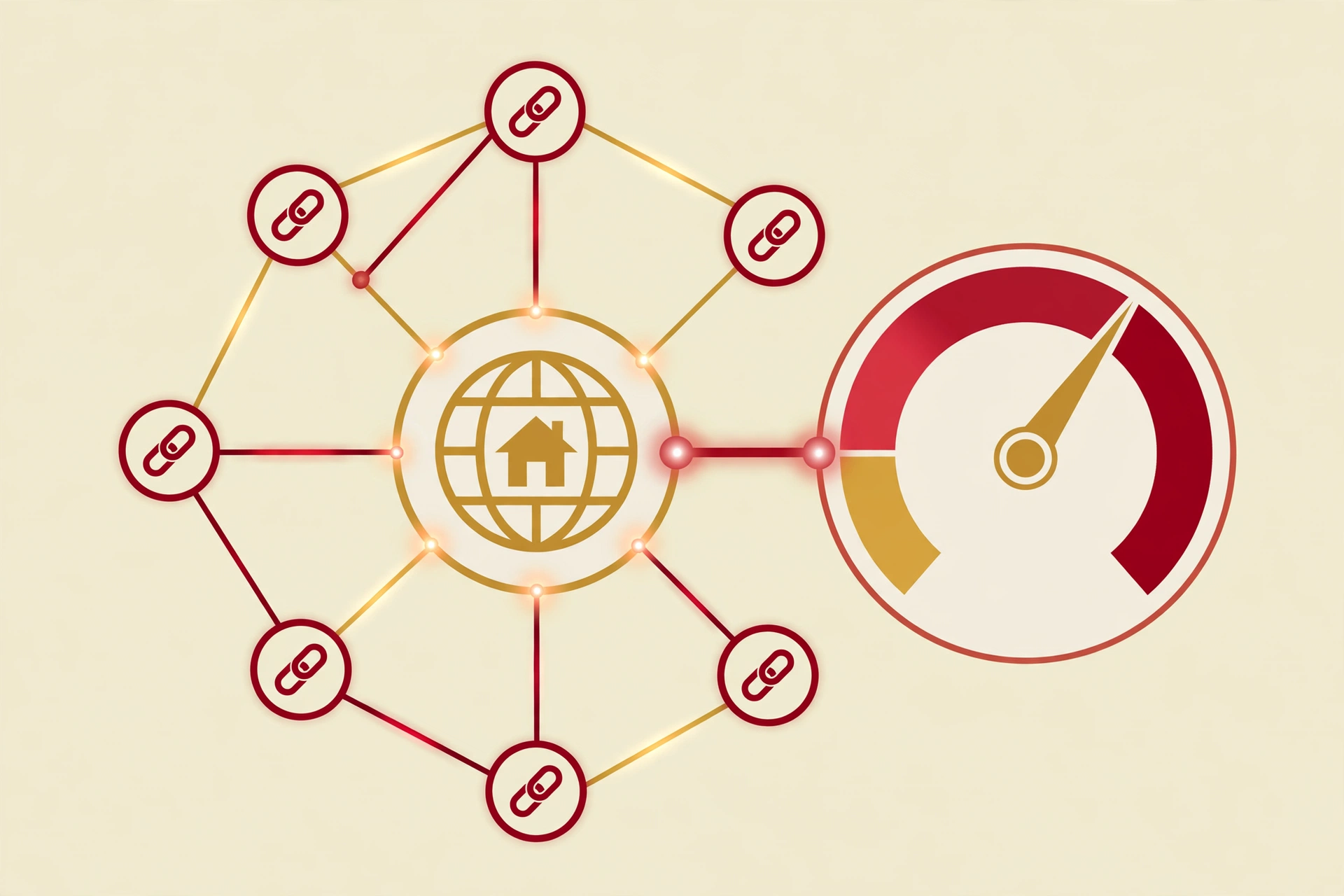
Ever refreshed a backlink tool hoping to see your Domain Rating tick upward, only to watch it sit still — or drop? Learning how to improve Domain Rating starts with your baseline: run our free domain authority checker first. DR summarizes how powerful your backlink profile looks — this guide shows what actually moves the number.
On this page
- What Domain Rating Actually Measures
- Check Your Current DR First
- What Actually Moves DR (Ranked by Impact) — the Core of How to Improve Domain Rating
- The 90-Day Plan for How to Improve Domain Rating
- DR Killers: What Lowers or Stalls Your Rating (and stalls how to improve domain rating efforts)
- Honest Expectations and Timelines for How to Improve Domain Rating
Most advice on this topic is either too vague (“just build more backlinks”) or too gimmicky (“buy cheap PBN links”). In this guide, you will learn exactly what Domain Rating measures, what actually moves the number (ranked by impact), a realistic 90-day plan for how to improve domain rating, the mistakes that stall progress, and honest timelines for different starting points.

What Domain Rating Actually Measures
Before trying to raise a number, you need to understand what the number is. Domain Rating (DR) is Ahrefs’ proprietary metric — a 0-to-100 score that estimates the strength of a website’s backlink profile. It is not a Google metric and Google does not use it in ranking. But because it correlates reasonably well with a site’s ability to rank, SEOs use it as a shorthand progress indicator — the same way a bathroom scale is not your health, but it tells you whether the trend is moving the right way.
The Ahrefs DR Formula in Plain English
Ahrefs calculates DR from two things: how many unique referring domains link to you, and how strong each of those domains is. The key insight most people miss is the word unique. The first link from a new domain carries almost all the value; the fiftieth link from that same domain adds almost nothing. This is by design — it rewards link-profile breadth, not volume.
The scale is also logarithmic. Going from DR 0 to DR 10 takes far fewer links than going from DR 70 to DR 80 — each step upward demands exponentially more link power. For the full technical breakdown, Ahrefs’ Domain Rating glossary entry explains the methodology directly from the source.
Practically, this means your DR strategy has exactly one lever that matters: earn links from new, strong domains. Everything in this guide flows from that single principle.
Domain Authority vs Domain Rating: Which One Matters?
You will often see DR discussed alongside Moz’s Domain Authority (DA). Both are third-party authority scores on a 0–100 scale, and both are logarithmic — but they measure different things and are not interchangeable:
- Domain Rating (Ahrefs) is purely a backlink metric: referring-domain count weighted by referrer strength. It ignores content, traffic, and on-page factors entirely.
- Domain Authority (Moz) predicts ranking potential using a broader machine-learning model that includes link data plus other signals — it correlates with rankings slightly differently and updates through Moz’s own index.
- Neither is used by Google. A high DR or DA does not directly cause rankings; both reflect the kind of link profile that tends to rank.
The practical rule: pick one metric, track it consistently, and compare yourself only against the specific competitors in your SERPs. If your rivals rank with DR 25–35, you do not need DR 70 to compete. Moz’s Domain Authority guide explains both scores side by side.
Check Your Current DR First
You cannot plan improvement without a baseline. Before doing anything else, record your current DR, the number of referring domains, and the same two numbers for three to five competitors who outrank you for your target keywords. A spreadsheet with six rows takes ten minutes and becomes the control panel for everything that follows.
How to Check Your DR for Free
Ahrefs’ own checker requires a subscription for full data, but you do not need one for the headline number. Use a free domain rating checker to see your DR and referring-domain count in seconds — no signup needed. Run the same check on your competitors’ homepages and log the results. Repeat this once a month; DR changes slowly, and weekly checking will only drive you mad.
Benchmark Against Real Competitors, Not the Whole Internet
A DR of 30 is weak if your SERP rivals are DR 60, and excellent if they are DR 15. Authority is relative. Pull the top-ranking pages for your five most important keywords, note the DR of each competing domain, and find the minimum DR that currently ranks. Your goal is to beat that number with margin — not to chase some abstract “high DR” that does nothing for your actual rankings.
What Actually Moves DR (Ranked by Impact) — the Core of How to Improve Domain Rating
Not all links are equal, and not all tactics move DR. Here are the four approaches that genuinely shift the number, ordered by how much DR they deliver per unit of effort. Notice the pattern: every single one is about earning links from new domains.

Digital PR and Newsworthy Content: the fastest way how to improve domain rating works
The single fastest legitimate DR mover is a link from a high-DR news site — one link from a DR 80 publication can do more for your score than a hundred links from DR 10 blogs. Digital PR means creating something journalists want to cover: an original survey, a data-driven ranking (“the 20 fastest-growing cities for remote work”), or a genuinely newsworthy announcement.
You do not need a PR agency to start. A small original study — even a survey of 200 customers in your niche — gives journalists a headline with a number in it. When coverage lands, it usually comes from high-DR domains you could never reach by guest posting, and each one is a brand-new referring domain.
Guest Posting on Real Sites in Your Niche — steady progress on how to improve domain rating
Guest posting remains one of the most reliable ways to earn links from new domains, with one non-negotiable condition: the site must be real. A real site has organic traffic, a genuine audience, editorial standards, and content beyond guest posts. A PBN-style “guest post farm” with zero traffic may show a DR number in a tool, but its links carry little weight and, at scale, look like a paid link scheme to Google.
Target sites with DR equal to or higher than yours, pitch one genuinely useful topic tailored to their audience, and write the best article on that topic the site has ever published. One excellent guest post per month on a legitimate site beats ten thin posts on irrelevant blogs. For the full playbook, see our guide to guest posting on real sites.
Resource-Page and Broken-Link Building — quiet workhorses for how to improve domain rating
Resource pages — “helpful links” lists — exist to link out. Find them with your-keyword + intitle:resources searches, then suggest your best content for inclusion. Broken-link building adds a favor: find a dead link on a resource page, alert the webmaster, and offer your content as the replacement. Slower than digital PR but highly consistent: a steady stream of these links from new domains compounds into real DR movement over a quarter.
Original Data and Studies That Get Cited
The most linkable asset class on the internet is original data. Journalists, bloggers, and even competitors cite statistics — and every citation is a potential referring domain. You do not need a research department: aggregate public data into a useful ranking, run a small poll of your own audience, or publish your internal benchmarks (anonymized) as an industry report.
The compounding effect is what makes this tactic special. One good study earns links for years as new writers discover it, so a single effort keeps adding new referring domains long after publication. Pair this with a backlink gap analysis of competitors’ most-linked content to see exactly which data formats earn links in your niche — then build something better.
For a deeper list of link-earning plays beyond these four, our guide on getting high-authority backlinks breaks down additional tactics with step-by-step detail.
The Middleman Strategy: Build Links to Assets, Funnel Authority Inward
High-authority sites rarely link to your sales pages — they link to educational resources. The middleman strategy exploits that: build one outstanding linkable asset (a free tool, a calculator, an original data study), aim all your high-DR link building at that asset, then use internal links to pass the authority from the asset to your commercial pages. You earn the link easily because the content is genuinely valuable, and your money pages still benefit from the authority flow. This is how to improve domain rating efficiently — concentrate new referring domains on the pages most likely to earn them, then distribute the gains internally.
The 90-Day Plan for How to Improve Domain Rating
Here is a realistic month-by-month plan for a small site starting between DR 0 and DR 30. Adjust the targets to your baseline — the structure works at any level.
| Month | Focus | Target new referring domains |
|---|---|---|
| Month 1 | Foundation: fix technical issues, reclaim unlinked brand mentions (search your brand name and ask sites that mention you to link), submit to a handful of legitimate directories and industry listings. | 5–10 |
| Month 2 | Outreach: publish 2–4 guest posts on real niche sites, pitch 30+ resource pages, run one broken-link-building campaign on competitor 404s. | 8–15 |
| Month 3 | Digital PR: publish one original data study or survey, pitch it to 50–100 journalists and niche bloggers, follow up once. | 10–25 (varies widely) |
That is 23–50 new referring domains in a quarter — a pace that is aggressive but safe, because every link is editorial and earned. At DR 0–30 this is typically enough to move the number by 5–15 points. Higher DR ranges need bigger absolute numbers; the plan scales by increasing outreach volume and PR ambition, not by cutting corners.
DR Killers: What Lowers or Stalls Your Rating (and stalls how to improve domain rating efforts)
Raising DR is only half the game — you also have to stop the leaks. These are the three most common reasons sites stall or slide backward.
Losing Referring Domains (Link Rot)
Pages get deleted, sites shut down, and webmasters redesign and drop old links. The average site quietly loses a few percent of its referring domains every year, and that attrition eats directly into DR. Run a lost-links report monthly in any backlink tool, and for the valuable ones — high-DR domains that dropped you — send a polite email asking if the link can be restored. Reclaiming an existing link is far cheaper than earning a new one.
Toxic and Spammy Links
A flood of spammy links — casino, pharma, or obvious PBN footprints — will not help your DR and can drag your rankings down if Google decides the pattern looks manipulative. Audit your link profile regularly and learn to spot toxic backlinks before they accumulate. Use the disavow tool only for clear-cut spam you cannot get removed; disavowing aggressively is its own way to hurt yourself. Google’s spam policies spell out exactly which link schemes cross the line — read them before you pay anyone for “link packages.”
Why DR Sometimes Drops When You Gain Links
This confuses almost everyone the first time it happens. Because the scale is logarithmic and Ahrefs periodically recalculates its index, your DR can dip even in a month you earned good links: a high-DR referrer may have dropped you, or an index update re-weighted your tier. A one- or two-point wobble is noise. A sustained multi-month decline is a signal — investigate lost links first.
Honest Expectations and Timelines for How to Improve Domain Rating
DR 0–20 Moves Fast; DR 40+ Is a Grind
The logarithmic scale cuts both ways. New sites often hit DR 15–20 within a few months of consistent, honest link building — a few dozen referring domains from decent sites will do it. Climbing from DR 30 to DR 40 takes substantially more: you need links from domains that are themselves hard to earn links from. Above DR 50, you are competing with established brands, and progress is measured in quarters, not weeks. Set your targets accordingly: beat your SERP competitors, not some round number.
DR Is Not a Google Ranking Factor
This is the point worth repeating, because it reframes the whole effort. Google does not know or care about your DR. It cares about the underlying reality DR approximates: real websites with real audiences choosing to link to you. Every tactic in this guide works because it earns those links — the DR increase is just the scoreboard confirming the work is working. Track DR alongside organic traffic and rankings; if traffic is climbing while DR wobbles, you are winning where it counts.
And one final warning: never buy links to inflate DR. Paid link schemes are exactly what Google’s link-spam systems target, and a manual action will cost you far more than any vanity metric is worth. The sites with the highest DR got there by being worth linking to. That is how to improve domain rating without shortcuts: be worth linking to — consistently, for 90 days — and the number will follow.
Done-for-you podcast backlinks
Get your brand on Apple Podcasts, Spotify, Amazon and 25 more trusted platforms — placed by hand, reported link by link.