

Building topical authority means becoming the site search engines and readers trust most on one specific subject. You do it with the pillar-cluster model: one comprehensive pillar page covering the core topic, surrounded by cluster articles that go deep on every subtopic, all connected through deliberate internal linking. Publish 20-30 tightly connected articles inside one topic before judging results.
On this page
- What Is Topical Authority?
- Why Topical Authority Matters More in 2026
- The Pillar-Cluster Model Explained
- Choose Your Topic and Build a Topic Map
- Create the Pillar Page and Cluster Content
- Connect Everything With Strategic Internal Linking
- Measure, Update, and Avoid the Common Traps
- Frequently Asked Questions
Most websites fail at this because they publish randomly. If you are new to the broader discipline, our complete guide to link building in SEO shows how this same focus principle applies to earning backlinks.
What Is Topical Authority?
Topical authority is the degree to which a website is recognized — by readers and by search engines — as a credible, comprehensive source on a defined subject. It is a practitioner concept: a useful shorthand for the observable pattern that sites covering one topic deeply tend to rank for more keywords within that topic, including keywords they never deliberately targeted.
One important nuance: Google has documented something called “topic authority,” but specifically in the context of news and original reporting — how it surfaces authoritative news sources for developing stories. Google’s ranking systems guide confirms its systems work mainly at the page level while also using site-wide signals. Moz’s own topic cluster guide covers the same architecture from the practitioner side.
In practice, topical authority shows up as breadth plus depth plus connection. Depth means each piece is genuinely complete, not a 400-word gloss. A site with 30 thin disconnected posts about “SEO” has less topical authority than a site with 20 thorough, interlinked posts about “technical SEO for WordPress.” Focus beats volume, every time.
Why Topical Authority Matters More in 2026
Three shifts have made topical authority more valuable than at any point in SEO history. The first is how people search. Queries are longer, more conversational, and increasingly answered by AI summaries and answer engines. These systems do not just match keywords — they synthesize from sources they consider authoritative on the topic. A site with demonstrated depth on a subject is far more likely to be cited in an AI-generated answer than a site with one good page floating in a sea of unrelated content.
The second shift is competition density. For most commercial topics, the top 10 results are now occupied by sites that all have decent on-page SEO and reasonable backlinks. When the basics are table stakes, the differentiator becomes who covers the topic most completely. Google’s own guidance keeps pushing toward this: helpful, reliable, people-first content written by people with real experience. A focused site with 25 articles on one subject simply has more surface area to demonstrate experience than a generalist site with 3.
The third shift is efficiency. A topical cluster is antifragile by design: when one cluster page slips, sibling pages and the pillar often hold or absorb the traffic. That compounding effect is the entire point. Backlinko’s topical authority hub reaches the same conclusion from a different angle: depth of coverage is what separates sites that rank for entire topic areas from sites that rank for single pages.
The Pillar-Cluster Model Explained
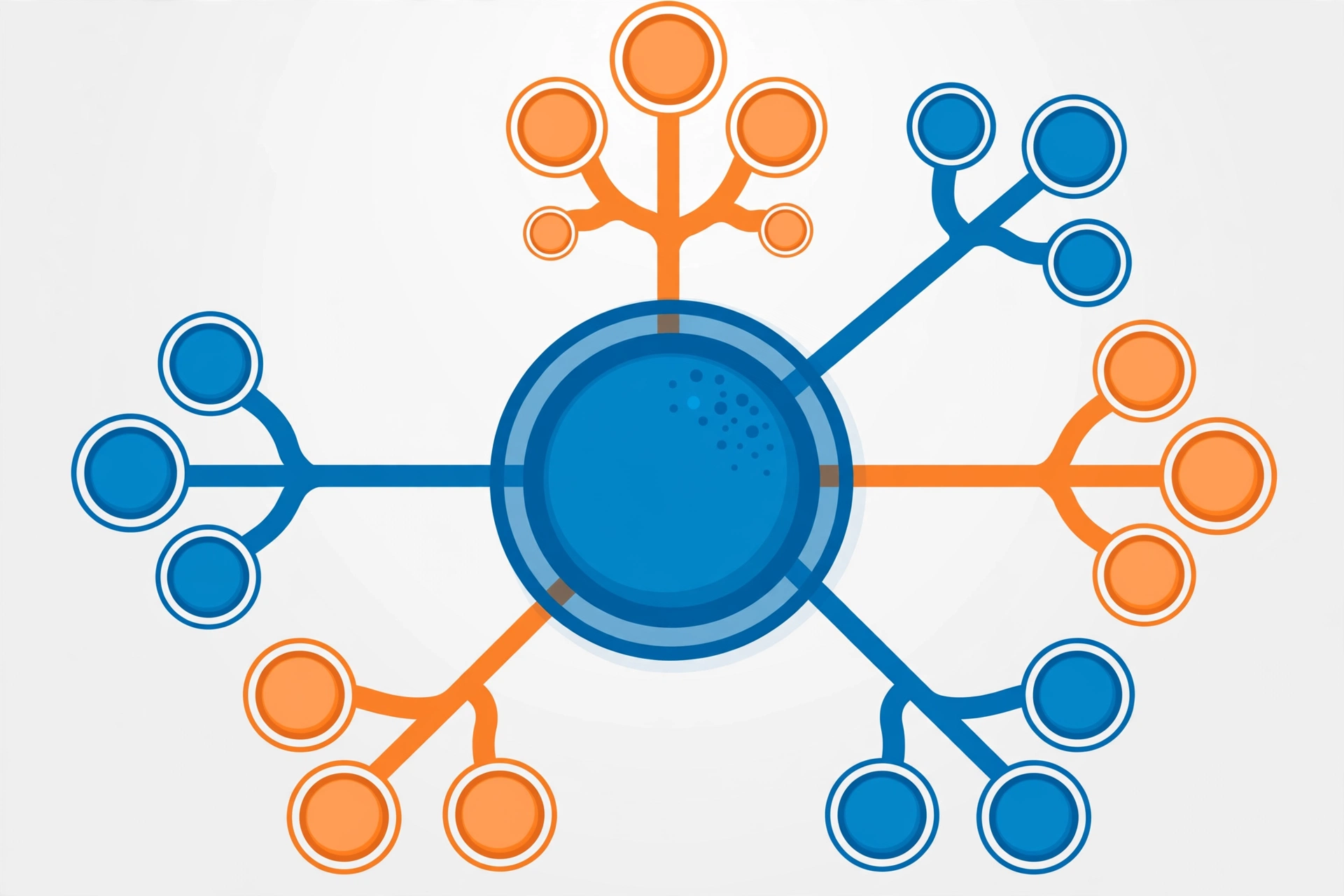
Every working topical authority strategy uses some version of the pillar-cluster model. It is the page you want ranking for the head term, and it is usually your most linkable asset. Each cluster page links up to the pillar using descriptive anchor text, the pillar links back down to its clusters, and cluster pages link to relevant siblings.
This shape matters because authority and relevance flow through internal links. The pillar accumulates external backlinks since it is the most comprehensive, most cited resource. Internal links push some of that strength down to cluster pages, which rank for narrower long-tail terms. The clusters, in turn, pass topical relevance back up to the pillar, telling Google this site has dozens of articles about this exact subject, all referencing each other coherently. That loop is what compounds over time.
The model also enforces topic discipline, which is half the battle. If you cannot decide which pillar a new post belongs under, the post probably should not exist yet. That single rule prevents the random publishing that kills most sites’ topical focus. For the linking mechanics that make this architecture work, see our internal linking playbook — the pillar-cluster model lives or dies on how deliberately you connect pages.
Here is how the model compares to the alternatives most sites default to:
| Approach | Structure | Topical Signal | Typical Outcome |
|---|---|---|---|
| Pillar-cluster | 1 pillar + 8-15 clusters, deliberate linking | Strong — clear hierarchy and coverage | Ranks for head term + long-tails; compounds |
| Random blogging | Unrelated posts, ad-hoc links | Weak — no discernible focus | Occasional lucky rankings; no momentum |
| Single mega-guide | One long page, no supporting content | Moderate — depth without breadth | Ranks for the head term only; misses long-tails |
| Thin cluster spam | Many shallow pages targeting keyword variants | Negative — reads as manipulation | Algorithmic suppression; wasted effort |
Verdict: The pillar-cluster model is the only architecture where each new article makes every existing article stronger. That compounding is the whole game.
Choose Your Topic and Build a Topic Map
Start by niching down further than feels comfortable. “Digital marketing” is not a topic — it is an industry. “Link building for SaaS startups” is a topic. “Technical SEO for WordPress” is a topic. The narrower your focus, the faster you build authority, because every article reinforces the same signals instead of scattering them. You can always expand later once the first pillar is established; most successful sites grew outward from one strong cluster, not inward from a vague broad one.
Once the topic is chosen, build a topic map before writing anything. List every subtopic, question, comparison, and task a person interested in your topic might care about. Pull from Google’s “People Also Ask,” related searches, Reddit threads, Quora questions, competitor tables of contents, and your own customer conversations. A practical target: 25-40 distinct content ideas organized under 3-5 sub-clusters. If you cannot generate 25 legitimate ideas, your topic may be too narrow to sustain a site — widen slightly and try again.
Organize the map into a hierarchy. At the top sits the pillar topic. Below it, 3-5 cluster themes (for link building, these might be “link building basics,” “outreach,” “analysis tools,” “advanced tactics”). Below each theme, the specific articles. Mark each article’s search intent: informational, comparison, or transactional. This map becomes your publishing roadmap for the next six months — and your filter for rejecting off-topic ideas that would dilute your focus.
Be honest about one thing during mapping: coverage without quality is worthless. Publishing 30 thin pages to “complete the map” will hurt you, not help. Google can detect filler. Every item on your map must be something you can cover genuinely well — with original insight, real examples, or data. If a subtopic would just be a rehash of what is already ranking, either find a genuinely better angle or cut it from the map.
Create the Pillar Page and Cluster Content
Write the pillar page first. Cover every major subtopic at a summary level, with each section linking forward to the cluster article that covers it in depth (or a placeholder note if that cluster is not written yet). A pillar stuffed with fluff to hit a number is worse than a tight 2,000-word pillar that actually answers everything.
Then publish cluster content steadily — one to two pieces per week is a sustainable pace for most teams. Each cluster article targets one specific subtopic or question from your map and goes genuinely deep: 1,200-2,000 words with examples, data, or original analysis. Every cluster page must link back to the pillar with anchor text containing the pillar’s primary keyword, and to 2-4 relevant sibling clusters. Never publish an orphan — a cluster page with no internal links in or out contributes nothing to the architecture.
Quality discipline matters more here than anywhere else in SEO. Each cluster article should be able to stand alone as the best answer to its specific query. If you are tempted to split one good article into three thin ones to inflate your “coverage,” resist it — that is exactly the filler strategy that gets sites suppressed. One outstanding cluster page outperforms five mediocre ones, both for rankings and for earning the backlinks that feed the whole system.
As your cluster grows, your pillar becomes more linkable, which lifts the entire structure. Original data, free tools, and definitive frameworks earn the most links — so plan at least one linkable asset per pillar. Our guide on how to boost domain authority covers the link-earning tactics that supply the external authority your pillar-cluster system needs to compound.
Connect Everything With Strategic Internal Linking
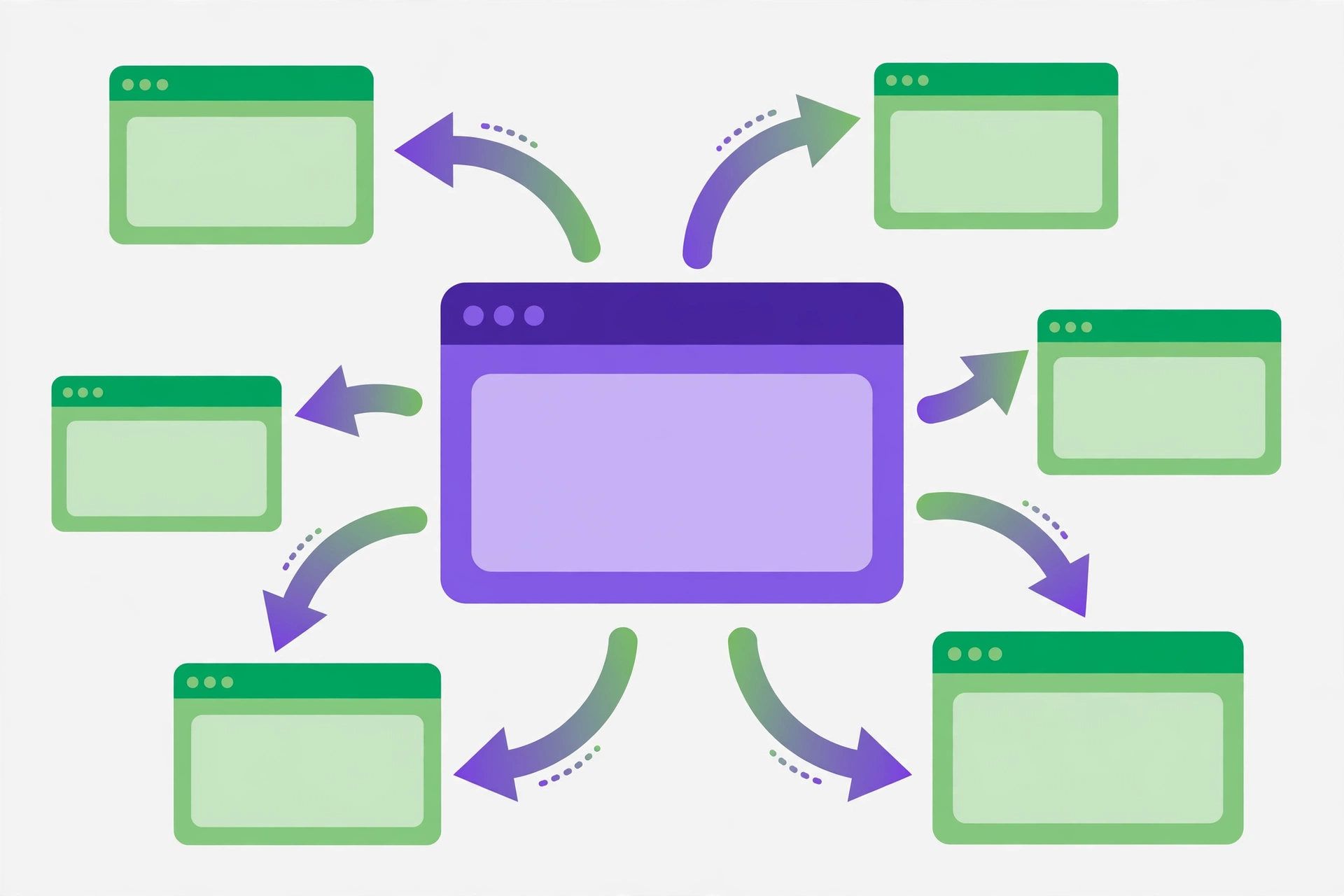
Internal linking is the glue of topical authority — and the step most sites botch. The rules are simple but non-negotiable. Every cluster page links up to the pillar. The pillar links down to every cluster. Related clusters link to each other where a reader would genuinely benefit. Use descriptive anchor text that includes relevant keywords naturally — “our guide to anchor text optimization,” not “click here.” And audit quarterly for orphans: any published page with zero internal links pointing to it is dead weight in your architecture.
Think about link equity flow deliberately. Your pillar will attract the most external backlinks over time. Each internal link from the pillar passes some of that strength to the cluster it points to — so make sure your highest-priority clusters are linked prominently, ideally with contextual links inside the pillar’s body content rather than buried in a footer list. Conversely, do not waste pillar links on low-priority pages; every link is a vote, and votes spent on trivia are votes not spent on money pages.
Anchor text deserves its own discipline. Vary it naturally across the site — if fifty internal links all use the exact phrase “topical authority guide,” that looks engineered. Mix exact-match, partial-match, and natural phrasing the way a thoughtful editor would. The goal is a link graph that reads as editorial judgment, because that is what it should be. Google’s systems are increasingly good at distinguishing genuine topical structure from manufactured silos, and the difference is almost always in the details of how pages connect.
One advanced move: build “bridge” content between clusters when you spot gaps. The denser the legitimate connections, the stronger the topical signal. Google’s ranking systems guide confirms its systems evaluate pages individually while also weighing site-wide signals — exactly the dynamic internal linking shapes.
Measure, Update, and Avoid the Common Traps
Topical authority compounds over months, not days — so measure on the right timeline. Track three things: keyword footprint growth within your topic (how many topic-relevant keywords you rank for, per Search Console), pillar and cluster ranking movement for target terms, and the share of traffic coming from long-tail queries you never deliberately targeted. That last metric is the purest signal of topical authority: when Google starts trusting you for questions you did not optimize for, the system is working.
Expect the first meaningful movement at 3-6 months with consistent publishing, assuming roughly 20-30 quality articles in the cluster. Diagnose honestly before publishing more.
Maintenance is the unglamorous half of the strategy. Refresh the pillar page quarterly — update statistics, add new sections for subtopics you have since covered, fix dead outbound links. Update cluster pages when their subject matter changes. And prune: if a cluster page consistently gets zero traffic, zero links, and zero engagement after a year, consider merging it into a stronger sibling rather than letting thin content dilute the cluster. A smaller, stronger cluster beats a larger, weaker one.
Finally, avoid the traps. Do not go too broad — “marketing” is not a topic you can own. Do not publish filler to hit an article count — thin content actively harms the cluster. Do not neglect E-E-A-T signals: real author bios, cited sources, and original experience matter more with every update. And do not treat topical authority as a substitute for backlinks — the two compound together. The sites that dominate topics pair deep coverage with genuine link earning; coverage alone, without any external validation, has a ceiling.
Verdict: Pick one topic, map it fully, publish 20-30 excellent interlinked articles over six months, and measure the long-tail footprint. That is the entire playbook — the difficulty is entirely in the discipline, not the complexity.
Frequently Asked Questions
How long does it take to build topical authority?
Expect 3-6 months of consistent publishing before meaningful movement, assuming 20-30 quality articles in a single topic cluster. It is not a one-page tactic — authority compounds as coverage deepens and internal links accumulate. Sites that publish sporadically or across scattered topics may never build it at all.
How many articles do I need for topical authority?
Roughly 20-30 tightly connected articles inside one pillar-cluster system is the threshold where Google typically starts treating a site as an authority on the subject. Below that, the signal is too sparse. Focus on one topic until you cross that threshold before expanding to a second pillar.
Is topical authority a Google ranking factor?
Not as a single confirmed factor with a published score. Google has documented “topic authority” for news queries, but the broader SEO concept of topical authority is a practitioner model describing how deep, well-connected coverage earns ranking signals. Google’s systems work mainly at page level while using site-wide signals — topical authority is a strategy for earning those signals.
Can a new website build topical authority?
Yes — and it is actually one of the best strategies for a new site. A new domain cannot compete on raw domain authority, but it can out-focus established generalist sites within a narrow topic. Pick a tight niche, publish 20-30 excellent interlinked articles, and earn links to the pillar. Focus is the new site’s unfair advantage.
What is the difference between topical authority and domain authority?
Domain Authority (DA) is Moz’s third-party metric predicting a whole domain’s ranking strength on a 1-100 scale. Topical authority is a strategic concept about being the trusted source on one specific subject through deep, connected coverage. DA measures overall link-based strength; topical authority describes subject-matter depth. A site can have modest DA but strong topical authority in its niche.
Do I need backlinks to build topical authority?
Content depth alone has a ceiling — the strongest topical authority comes from pairing comprehensive coverage with genuine link earning. Internal linking distributes relevance within your cluster, but external backlinks (especially to the pillar page) provide the validation Google weighs heavily. Build both: the cluster earns the right to rank, links supply the authority to do it.
Done-for-you podcast backlinks
Get your brand on Apple Podcasts, Spotify, Amazon and 25 more trusted platforms — placed by hand, reported link by link.