

Some blog posts earn traffic for a week. Others keep bringing visitors for years. The difference comes down to one concept: evergreen content.
On this page
- What Is Evergreen Content?
- Evergreen Content vs. Trending Content
- Why Evergreen Content Is an SEO Asset
- Evergreen Content Examples
- How to Find Evergreen Topics
- How to Create Evergreen Content
- Keeping Evergreen Content Ranking: The Refresh Workflow
- Measuring Evergreen Content Performance
- Frequently Asked Questions
- Final Thoughts
In this guide, you’ll learn exactly what evergreen content is, see real examples across different formats, discover how to find evergreen topics in your niche, and — most importantly — how to keep your evergreen posts ranking year after year with a simple refresh workflow. Whether you’re starting a new blog or trying to get more from content you’ve already published, this is the complete playbook.
What Is Evergreen Content?
Evergreen content is content that stays relevant and continues to earn search traffic long after it’s published. Unlike news articles or trend pieces that lose value within days, evergreen content addresses topics people search for consistently, month after month, year after year.
Think of it like the difference between a daily newspaper and a reference book. The newspaper is outdated tomorrow; the reference book stays useful for years.
Here’s the key point most guides miss: “evergreen” does not mean “never needs updates.” The best evergreen content is actively maintained. Facts change, screenshots go stale, new developments emerge — and the posts that keep ranking are the ones whose authors treat them as living documents, not one-time publications.
Evergreen Content vs. Trending Content
Not all content should be evergreen. A healthy content strategy needs both. Here’s how they compare:
| Evergreen Content | Trending Content | |
|---|---|---|
| Lifespan | Years | Days to weeks |
| Traffic pattern | Slow build, then compounding steady traffic | Sharp spike, then rapid decay |
| Effort profile | High upfront effort, low ongoing maintenance | Low effort per piece, but constant production needed |
| Link-earning potential | High — becomes the reference others cite | Low — few link to yesterday’s news |
| Examples | “How to tie a tie,” “what is SEO,” beginner guides | Product launches, news reactions, viral moments |
The strategic takeaway: evergreen content is the compounding base of your blog. Trending content can deliver quick wins and social shares, but evergreen posts are what build durable organic traffic that grows while you sleep.

Why Evergreen Content Is an SEO Asset
Evergreen content isn’t just a nice-to-have — it’s one of the highest-ROI investments in SEO. Here’s why:
1. Compounding organic traffic. A trending post might get 5,000 visits in its first week and then flatline. A strong evergreen post might start at 50 visits a month, grow to 500, then 2,000 — and hold there for years. Over a two-year window, one solid evergreen post routinely outperforms twenty news-style posts combined.
2. Passive backlink earning. Evergreen guides become the resources other writers link to when covering a topic. Nobody links to a three-day-old news recap, but a definitive “ultimate guide” accumulates backlinks naturally over time — which in turn strengthens its rankings further. It’s a virtuous cycle.
3. Lower cost per visit over time. News-chasing demands constant production to maintain traffic. Evergreen content front-loads the effort: you invest heavily once, then maintain lightly. The cost per visitor drops every month the post keeps ranking.
4. Topical authority foundation. Search engines increasingly reward sites that cover topics deeply rather than chasing scattered keywords. Evergreen pillar posts — comprehensive guides on core topics in your niche — signal to Google that your site owns the subject. Supporting posts then link back to these pillars, concentrating authority.
Evergreen Content Examples
Evergreen content comes in many formats. Here are the most reliable ones, with concrete examples:
Ultimate guides. Comprehensive, definitive resources on a core topic — e.g., “The Complete Guide to Keyword Research” or “Internal Linking Best Practices.” These are the classic link magnets. (For a deeper look at what makes guides rank, see Ahrefs’ breakdown of evergreen content.)
Tutorials and how-tos. Step-by-step instructions for tasks people always need to do — “How to Set Up Google Search Console,” “How to Write a Meta Description.” As long as the underlying process doesn’t fundamentally change, these stay relevant for years.
Glossaries and definitions. “What is domain authority?” “What are backlinks?” Beginner definitions in any niche have remarkably stable search demand. They’re also prime candidates for featured snippets because they answer a clean, direct question.
Checklists and templates. “SEO Audit Checklist,” “Content Calendar Template.” These earn bookmarks, return visits, and shares — engagement signals that reinforce rankings. People don’t just read checklists; they use them repeatedly.
Framework and methodology posts. Original processes with named steps — “The 5-Step Link Outreach Framework.” These get cited by other creators (earning backlinks) because they offer something quotable and proprietary, not just rephrased consensus.
How to Find Evergreen Topics
Not every topic in your niche is evergreen. Here’s how to identify the ones with lasting power:
1. Mine timeless questions. Look for questions that repeat year after year: forum threads that get revived annually, “people also ask” boxes with fundamental questions, customer support queries that never stop coming. If people asked it in 2020 and are still asking in 2026, it’s evergreen.
2. Look for stable keyword signals. Before committing to a topic, validate it with a keyword volume checker. You’re looking for steady, consistent search volume — not spikes. A keyword with 1,000 searches every single month beats one with 10,000 searches in a single spike month.
3. Favor fundamentals over tactics. Fundamentals (“how internal linking works”) outlast tactics (“the exact outreach template that worked in March”). Tactics expire; principles endure. When in doubt, go one level more fundamental than your first instinct.
4. Check the existing SERP age. Search your candidate topic and look at the ranking pages’ publish dates. If the top results are 3–5 years old and still ranking, that’s strong evidence the topic is evergreen — and it also tells you that freshness alone won’t dislodge them; you’ll need genuinely better depth.
How to Create Evergreen Content
Writing content that lasts requires different choices than writing for the moment:
Use timeless framing. Avoid anchoring your post to a moment in time: no “in 2024” in the title, no news hooks in the intro, no version-specific screenshots where avoidable. Write so the post reads naturally whether someone finds it this year or in three years. (Google’s own helpful content guidance rewards content written for long-term user value over content chasing the moment.)
Build update-friendly structure. Organize the post into modular sections that can be refreshed independently. If statistics live in one clearly-marked section, updating them next year takes twenty minutes instead of a full rewrite. Think of each H2 as a replaceable component.
Go deep, not broad. The posts that survive are the ones that become the reference on a topic. Cover it completely: definitions, why it matters, step-by-step how-to, examples, mistakes, FAQs. A shallow post gets replaced; a definitive one gets linked to. As Search Engine Journal notes, depth is what separates lasting content from disposable content.
Answer the next question too. Evergreen posts earn return visits and longer dwell time when they anticipate follow-up questions. After explaining what, cover how, then what to avoid, then how to measure. Each layer makes the post harder to displace.
Keeping Evergreen Content Ranking: The Refresh Workflow
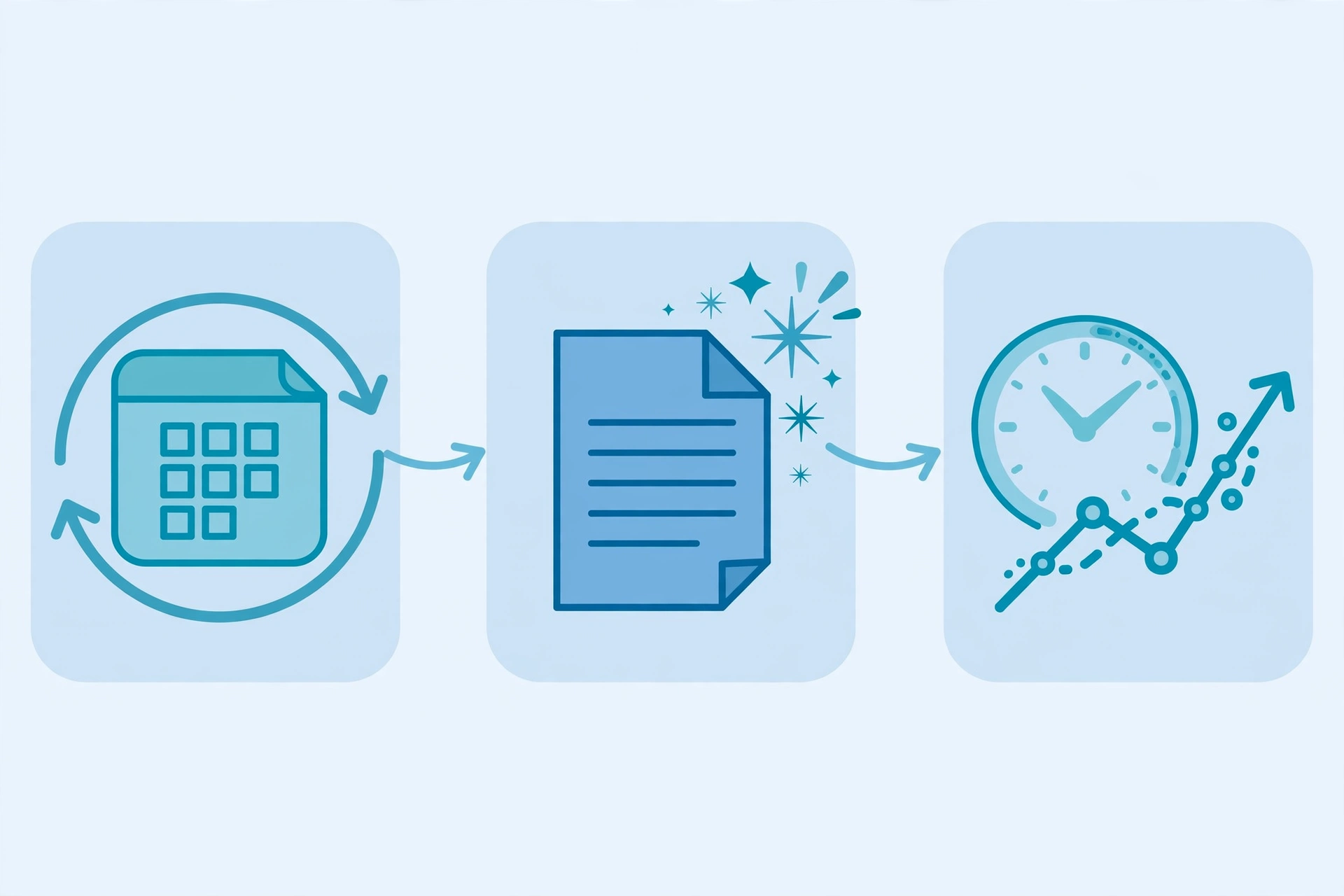
Here’s the part most “evergreen content” guides skip: rankings decay. Even great evergreen posts slowly slip as facts age, screenshots go stale, competitors publish fresher versions, and Google’s understanding of intent evolves. The 2026 consensus among SEOs is clear: content refresh beats constant publishing.
Here’s a practical refresh workflow:
Step 1: Build a refresh queue. In Google Search Console, track impressions and clicks per URL over 12+ months. Flag any important post with a sustained 15–20% decline — that’s your refresh queue. Review the queue quarterly.
Step 2: Audit what’s stale. Open the post and check: Are statistics current? Do examples still make sense? Are screenshots from the current version of any tools mentioned? Have new subtopics emerged that deserve a section? Is anything factually wrong now?
Step 3: Update surgically. You rarely need a rewrite. Typically: refresh the stats, swap stale examples, add 1–2 new subsections covering recent developments, and tighten anything that’s gotten wordy. Ahrefs’ content refresh guide shows how targeted updates — not rewrites — recover rankings fastest.
Step 4: Strengthen internal links. Link the refreshed post from newer relevant articles, and add links from the refreshed post out to newer posts. This redistributes authority and signals to Google that the post is part of a living, maintained topic cluster. (See our guide to our internal linking guide for the full method.)
Step 5: Update the date and republish. Change the “last updated” date (not the original publish date — keep both visible for transparency), then request reindexing in Search Console. A visible freshness signal plus substantive changes is what earns the ranking recovery.
Refresh cadence: review your top 10–20 evergreen posts every 6–12 months. High-traffic money posts deserve the 6-month cycle; supporting posts can go annual.
Measuring Evergreen Content Performance
Evergreen content should be judged on a longer timeline than other posts:
Track per-URL trends, not snapshots. In Google Search Console, look at each evergreen URL’s impressions and clicks over 12+ months. Healthy evergreen shows a gradual upward slope or a stable plateau. A downward slope lasting 3+ months means it’s entered the refresh queue.
Watch assisted value, not just direct clicks. Evergreen guides often assist conversions started elsewhere — someone reads your guide in March and buys in June. Check assisted conversions in analytics so you don’t undervalue posts that educate early-stage visitors.
Monitor backlink growth. A healthy evergreen post should accumulate referring domains steadily over time. If link velocity stalls while traffic holds, the post may need a promotion push or a refresh to become link-worthy again.
Benchmark against publish date. Compare each quarter’s traffic to the same quarter last year, not to last month. Evergreen performance is seasonal in many niches — year-over-year is the honest comparison.
Frequently Asked Questions
How long does evergreen content last?
There’s no fixed expiry date. Well-maintained evergreen content can rank for 5+ years. The key variable isn’t time — it’s maintenance. A guide refreshed annually can outlast a neglected post published last month. Plan for a 6–12 month review cycle and your evergreen posts can keep performing indefinitely.
Can news-style content become evergreen?
Sometimes. A news post that gets substantially expanded into a definitive guide on the underlying topic can transition. For example, coverage of a Google algorithm update can evolve into an evergreen “Google algorithm updates explained” reference. But most news posts are better left as-is — trying to force evergreen status on time-bound content usually produces neither good news nor good evergreen content.
How many evergreen posts does a blog need?
Quality beats quantity. Ten deeply-maintained evergreen pillars outperform fifty thin ones. Start with 3–5 covering your niche’s core topics, maintain them well, then expand. Each new evergreen post should fill a genuine gap — not overlap existing pillars.
Does updating the publish date help rankings?
Updating the date alone does almost nothing. What helps is substantive refreshing — new facts, new sections, improved structure — combined with a visible “last updated” date. Google rewards genuinely refreshed content, not cosmetic date changes. Show both the original publish date and the last-updated date for transparency.
What’s the difference between evergreen and pillar content?
They overlap but aren’t identical. Pillar content is a structural role — a comprehensive hub page that cluster posts link to. Evergreen content is a longevity trait — content that stays relevant over time. The best pillar pages are evergreen, but not all evergreen posts serve as pillars. Ideally, your pillars are both.
Final Thoughts
Evergreen content is the closest thing SEO has to a compounding asset: invest deeply once, maintain lightly, and let traffic, links, and authority accumulate year after year. But “evergreen” is a maintenance commitment, not a write-and-forget label.
Start with one topic: find a timeless question in your niche, validate steady demand, write the definitive version, and put a 6-month refresh reminder on your calendar. Then repeat. A dozen well-maintained evergreen posts will outperform a hundred forgotten ones — every time.
Done-for-you podcast backlinks
Get your brand on Apple Podcasts, Spotify, Amazon and 25 more trusted platforms — placed by hand, reported link by link.