

Tiered link building is an SEO technique that organizes backlinks into layers: tier 1 links point directly to your site, tier 2 backlinks point to the pages that carry your tier 1 links, and tier 3 links point to your tier 2 pages. The idea is that link equity flows upward through the layers, making each tier 1 link pass more authority to your site. It is one of the most debated tactics in SEO — and most of what is sold under its name deserves the debate.
On this page
Before we go further, a straight answer. Understanding what backlinks are makes the tiers easy to grasp: a link is a vote, and some votes carry more weight. Tiered link building is simply the idea of campaigning for the pages that vote for you, instead of only campaigning for yourself. The mechanics are real. The way most vendors implement it is not.
What Is Tiered Link Building?
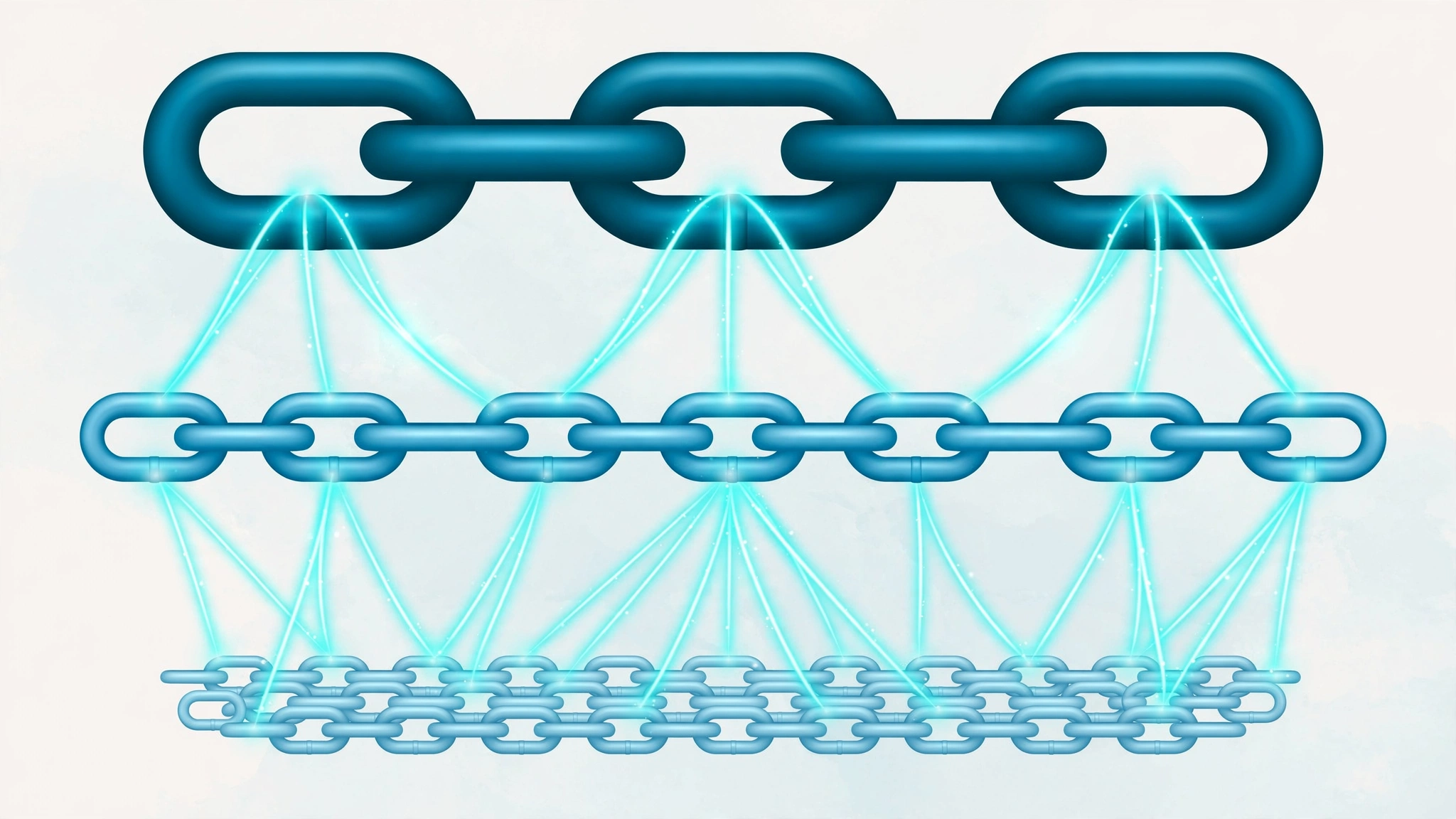
Picture three rows stacked like a pyramid. At the top sits your website — the money site. Below it, tier 1: a small number of high-quality links pointing straight at your pages. Below that, tier 2: a larger number of medium-quality links pointing at the tier 1 pages, not at you. And at the bottom, tier 3: an even larger volume of low-effort links pointing at tier 2. This whole structure is what some SEOs call link pyramid SEO.
The logic is straightforward. A link passes authority to the page it points to — that’s link equity in action. So a tier 1 link from a strong page passes more to your site if that tier 1 page itself has links pointing at it. Instead of building every link at tier 1 quality — expensive — you strengthen your best placements indirectly, at a lower cost per link. That is the pitch, anyway.
How the Tiers Work: Tier 1, Tier 2, and Tier 3 Backlinks
Each tier has a different job, a different quality bar, and a different cost. Here is how practitioners usually describe them:
| Tier | Points at | Typical quality | Typical volume | Job |
|---|---|---|---|---|
| Tier 1 | Your site directly | High — editorial, relevant | Low (a handful) | Move your rankings |
| Tier 2 | Your tier 1 pages | Medium — decent but not premium | Moderate | Strengthen the pages that link to you |
| Tier 3 | Your tier 2 pages | Low — often thin or automated | High | Keep tier 2 pages crawled and indexed |
Tier 1: The Links That Point at You
Tier 1 backlinks are ordinary, good links: guest posts on real publications, digital PR mentions, resource page placements, editorial references. They are the hardest to earn and the most valuable. Nothing about tier 1 is controversial — this is just link building.
Tier 2: The Links That Point at Your Links
Tier 2 backlinks are links to the pages that link to you. Say a blogger links to your site from a review article. Tier 2 means getting links — from forums, social shares, niche directories, newsletter mentions — to that review article. The theory: a stronger review article passes more equity through its link to you.
Tier 3: The Foundation Layer
Tier 3 exists to support tier 2. These are the easiest links to get: social bookmarks, profile links, blog comments, mass directory submissions. Quality is usually poor, volume is high, and in most implementations this is where automation takes over. It is also where the risk concentrates.
A Simple Tiered Link Building Example
Let us make it concrete. Imagine you run a small SaaS tool and a mid-size marketing blog publishes a genuine review of it, linking to your homepage. That review is your tier 1 link.
A tiered approach would then try to strengthen that review: the blogger shares it in their newsletter, it gets discussed in a relevant Reddit thread, someone cites it in a forum answer, and it is submitted to a couple of legitimate industry directories. Those are tier 2 backlinks — they never touch your site, but they raise the authority of the page linking to you.
Then tier 3 would add volume beneath that: bookmarking the forum threads, spinning up social profiles that share the review, mass directory submissions pointing at the tier 2 pages. This is where most campaigns stop looking like promotion and start looking like a machine. And that is exactly where Google’s systems start paying attention.
Notice what changed in this picture: your own site never touched a single low-quality link. Everything dubious happened two or three hops away. That distance is the whole selling point of the technique — and, as we will see, it is also the reason the technique is so easy to get wrong.
Why Some SEOs Still Use It
Strip away the hype, and the argument for tiered link building has three legs:
It multiplies earned links. Strengthening pages that already link to you may raise the value flowing from them, without the cost of earning new tier 1 placements. The effect is indirect and delayed, but the math of link equity makes the claim plausible.
It keeps low-quality links off your site. If any tier goes wrong, the reasoning goes, the damage lands on tier 2 or tier 3 pages — not your domain. Your backlink profile stays clean because nothing sketchy ever points at you directly.
Want to analyze any site’s backlink profile? Try our free website authority checker.
It is cheaper than building everything at tier 1 quality. Editorial links are expensive in time and money. Amplifying them with cheaper placements stretches the budget.
Here is the honest counterweight: all three benefits assume the lower tiers look natural. Automated tiers, repeated anchor text, and velocity spikes are exactly the patterns Google’s spam systems are trained to detect. The “protection” argument also has a hole — if a tier 1 page is deindexed or a tier 2 pattern is flagged, you do not get penalized directly, but the link equity you paid for simply stops flowing. Money spent, nothing kept.
Where Google Draws the Line
Google’s spam policies define link spam to include buying or selling links for ranking purposes, excessive link exchanges, and — the phrase that matters here — using automated services to create links. A tiered structure built by automation is, by that definition, a link scheme, regardless of how many layers it has.
The industry’s biggest tool vendor agrees. According to Distribb’s 2026 guide, Ahrefs classifies deliberate tiered link building as black-hat or gray-hat SEO, and states plainly that it violates Google’s guidelines. That is not a small blog’s opinion — it is the position of the largest link-data company in the industry.
Worth noting: Google’s systems do not only look at what points at your site. Its SpamBrain system evaluates link patterns more broadly, and links from pages that are themselves part of a manipulative structure may simply be ignored — meaning automated tiers can quietly contribute zero value long before they trigger anything worse. For the full text of the policy, see Google’s spam policies on link spam.

The Risks That Actually Trigger Penalties
Not every tiered structure gets penalized. But when they do, the causes are almost always the same handful of patterns. If you are evaluating anyone’s tiered offering — an agency’s or your own — check it against this list:
Footprints across “different” sites. Tier networks built on the same hosting, the same themes, the same WHOIS data, or the same content templates are trivially detectable as one operation. Private blog networks live or die on this point.
Unnatural anchor-text repetition. Dozens of tier 2 links using the same keyword-rich anchor pointing at one tier 1 page is a signal no real audience produces. Real sharing uses branded, naked-URL, and generic anchors in messy proportions.
Velocity spikes. A review page that sat quiet for a year and suddenly gains 200 links in a week looks manufactured, because it is. Natural amplification follows the rhythm of real discovery — slow, then sometimes spiky around a genuine event, never machine-regular.
Collateral collapse. Lower-tier pages get deindexed all the time. When your tier 2 properties vanish, the equity they were pushing upward vanishes with them — and the money you spent building them is gone too.
If you ever inherit a site with this kind of history, learn to recognize toxic backlinks before deciding whether cleanup is needed.
A Safer Tiered Link Building Strategy for 2026
Here is the uncomfortable truth most guides dodge: the mechanism of tiered link building is legitimate. Strengthening pages that link to you is just promotion. What makes it a scheme is how the lower tiers get built — automated, irrelevant, and designed for search engines rather than people.
So here is a tiered link building strategy that survives scrutiny, because every step would look defensible under manual review:
- Build tier 1 the white-hat way. Earn genuine editorial links through guest posting, digital PR, resource pages, and original research. This is the foundation everything else rests on — if tier 1 is real, the whole structure has a chance. Our guide to white hat link building covers the tactics in detail.
- Promote tier 1 pages like a publisher would. Share them in your newsletter. Mention them in relevant community discussions where they genuinely help. Send them to journalists covering follow-up stories. Ask partners to reference them. This is “tier 2” done by humans — and it is indistinguishable from normal content promotion, because it is normal content promotion.
- Skip tier 3 entirely. There is no legitimate version of automated bulk links pointing at your tier 2 pages. Whatever marginal crawl or equity benefit they promise, the risk profile is all downside for a real business.
- Measure what matters. Track the referral traffic and ranking movement of the pages you are amplifying, not the raw count of lower-tier links. If promotion is not producing real visits or movement within a few months, the problem is the tier 1 asset, not the lack of tier 3 volume.
The short version: keep the pyramid’s shape, throw away the pyramid’s machinery. Earn the top, promote the middle, and never build the bottom.
Frequently Asked Questions
What is tiered link building in simple terms?
It is building links in layers: your best links point at your site (tier 1), while additional links point at those tier 1 pages (tier 2) to make them stronger. Some practitioners add a third layer (tier 3) beneath that. The goal is to increase the authority flowing to your site without paying top-tier prices for every link.
How do tier 1, tier 2, and tier 3 backlinks differ?
Tier 1 links point directly at your website and should be high-quality, editorial, and relevant. Tier 2 backlinks point at your tier 1 pages and are usually medium quality — social shares, forum mentions, directories. Tier 3 links point at tier 2 pages and are typically low-quality, high-volume placements, often automated.
Is tiered link building against Google’s guidelines?
The automated version is. Google’s spam policies class link schemes — including using automated services to create links — as link spam, and Ahrefs classifies deliberate tiered link building as black-hat or gray-hat. Manually promoting pages that link to you is normal marketing; mass-producing lower tiers with software is where it crosses the line.
Is tiered link building still effective in 2026?
The honest answer: partially. Strengthening real pages that link to you can still pass more value, but the automated lower tiers that defined the classic “link pyramid SEO” playbook are increasingly ignored or flagged by Google’s spam systems. The effective part is the human promotion; the risky part is the automation.
What is a safe alternative to tiered link building?
Earn strong tier 1 links through white-hat tactics like guest posting, digital PR, and original research, then promote those linking pages the way a publisher would — newsletters, communities, social sharing, journalist follow-ups. You get the amplification effect of the tiers without building anything Google would call a scheme.
Done-for-you podcast backlinks
Get your brand on Apple Podcasts, Spotify, Amazon and 25 more trusted platforms — placed by hand, reported link by link.