

If you’ve wondered what is referring domain — a referring domain is a unique website that links to your site at least once. If five different pages on the same blog all link to you, that still counts as one referring domain. If five different websites each link to you once, that’s five referring domains — and for SEO purposes, those five separate votes of confidence carry more weight than five links from a single source.
On this page
- What Is a Referring Domain? (Simple Definition)
- Referring Domains vs Backlinks vs Referring Pages vs Referring IPs
- Why Referring Domains Matter More Than Total Backlinks
- What Makes a Referring Domain Valuable?
- How to Check Your Referring Domains (Free + Paid)
- How to Earn More Referring Domains
- Common Referring Domain Mistakes to Avoid
- Frequently Asked Questions
This one distinction — unique domains rather than total links — sits at the heart of how modern link building works. Search engines have long treated a link as a vote, but they’ve also learned that a hundred votes from the same voter aren’t a hundred independent endorsements. That’s why nearly every serious SEO tool reports referring domains as a headline metric, and why understanding the concept properly changes how you build and evaluate your link profile.
What Is a Referring Domain? (Simple Definition)
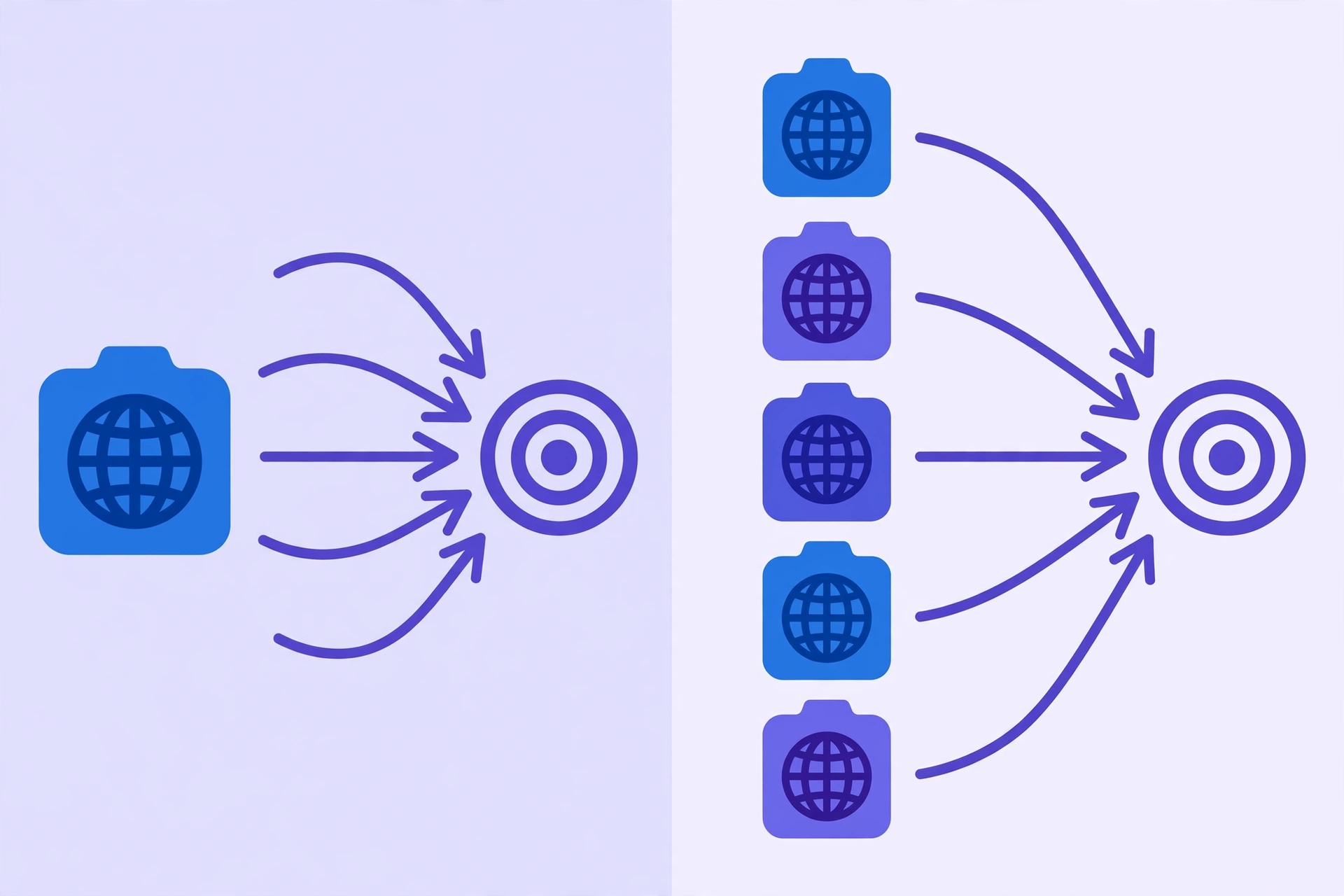
A referring domain is any domain that has at least one page linking to your website. The counting rule is simple: it’s the domain that matters, not how many links it sends you.
Here’s how the counting works in practice. Imagine a popular blog publishes three separate articles, and each one links to your site. You gained three backlinks — but only one referring domain. Now imagine three different websites each link to you once. Same three backlinks, but three referring domains. The second scenario is the stronger signal, because three independent sources decided your content was worth linking to.
SEO tools count this for you automatically. When Ahrefs, Semrush, or Moz show your referring domains number, they’re counting unique domains linking in — deduplicated. One domain sending you fifty links still appears as a single referring domain in those reports.
Think of it this way: backlinks are votes, and referring domains are voters. A page with 1,000 backlinks from 1,000 domains looks web-endorsed. The same 1,000 backlinks from 3 domains looks like a partnership or a network — search engines can tell the difference.
If you’re new to links in general, start with our pillar guide on what backlinks are and how they work — it covers the foundations this article builds on.
Referring Domains vs Backlinks vs Referring Pages vs Referring IPs
These four terms get mixed up constantly, so let’s separate them cleanly with a single example. Say the website example.com has 10 pages, and 4 of those pages each link to you once:
- Backlinks: 4 (the total number of links pointing to you)
- Referring pages: 4 (the number of unique pages linking to you)
- Referring domains: 1 (one unique domain — example.com)
- Referring IPs: 1 (usually — one server IP hosting the domain, though large sites may use several)
Now flip it. Four different websites — a.com, b.com, c.com, d.com — each link to you once from a single page:
- Backlinks: 4
- Referring pages: 4
- Referring domains: 4
- Referring IPs: probably 4 (different hosts, different servers)
Same backlink count, completely different profile strength. The second case is what link builders chase.
| Metric | What It Counts | Example |
|---|---|---|
| Backlinks | Total links pointing to your site | 50 links from 5 sites = 50 |
| Referring pages | Unique pages linking to you | 50 links across 30 pages = 30 |
| Referring domains | Unique domains linking to you | 50 links from 5 sites = 5 |
| Referring IPs | Unique server IPs linking to you | 5 sites on shared hosting = maybe 1–2 |
Referring IPs are the metric people forget. If 50 “different” links all sit on the same server, the IP footprint gives it away. A healthy profile keeps referring IPs roughly in line with referring domains.
We go much deeper into the head-to-head in our dedicated piece — read the full comparison of backlinks vs referring domains if you want the nuances, the edge cases, and which one to optimize for first.
Why Referring Domains Matter More Than Total Backlinks
Here’s the uncomfortable truth about link building: the total backlink count is one of the easiest metrics to inflate and one of the least meaningful. Google’s John Mueller has said the total number of backlinks pointing to a website is “irrelevant” to how the algorithm evaluates a site. That’s a strong word from someone who works at Google — and it tells you where the real signal lives.
The real signal is diversity of endorsement. When many independent domains link to you, each one represents a separate editorial decision by a separate site owner. That’s hard to fake at scale. When one domain links to you five hundred times, it represents one decision repeated — much easier to manufacture, and much less convincing.
The data backs this up. Ahrefs analyzed roughly a billion pages and found that pages with zero referring domains get essentially no organic traffic — links from new, unique domains are what move pages off zero. In a separate analysis of their 14-billion-page index, 96.55% of pages got zero search traffic, and among pages with no referring domains, only about 1 in 6,671 ever crossed 1,000 monthly visits. The pattern is consistent: without referring domains, pages don’t rank.
Correlation studies point the same way. In an analysis of one million keywords, referring domains showed a correlation of 0.255 with Google rankings — the strongest correlation of any link metric measured. To be clear, correlation is not causation: this doesn’t prove referring domains cause rankings, only that the two move together more tightly than any other link metric does.
The story is extending into AI search too. A December 2025 study by SALT.agency of 5,825 travel URLs found referring domains correlated 0.42 with Perplexity citations and 0.41 with Gemini citations — again, correlations, not proof of cause, and one industry’s data. But it’s early evidence that the diversity principle may carry over as search evolves.
And for calibration: Google’s Gary Illyes said at PubCon 2023 that links are “not a top 3 ranking factor” anymore. So referring domains matter — they’re the best link signal you have — but they’re one signal among many, and content quality, relevance, and user satisfaction still do heavy lifting.
The takeaway: evaluate referring domains first, total backlinks second. A site with 200 backlinks from 150 domains is almost always healthier than one with 2,000 backlinks from 12.
What Makes a Referring Domain Valuable?
Not all referring domains are equal. One link from a respected publication in your niche can outweigh dozens from random sites. Here’s what separates valuable referring domains from filler:
Topical relevance comes first. A link from a site that covers your topic tells search engines your content belongs in that conversation. A plumbing blog linking to a plumbing supplier makes sense. That same blog linking to a crypto exchange doesn’t — and irrelevant links carry less weight, sometimes none at all.
Real traffic and real audience. Domains with genuine visitors are worth more than domains that exist only to host links. If real people read the linking site, the link has a chance to send referral traffic too — which is value independent of any ranking effect.
Editorial standards. Was the link placed by a human editor who chose your content, or did it appear automatically in a footer, sidebar, or author bio across hundreds of pages? Editorial links — the kind someone chose to include because your content added value — are the gold standard. Sitewide links (the same link repeated on every page of a domain) still count as one referring domain, but their per-link value is typically diluted.
Authority of the linking domain. All else equal, a link from a strong, established domain passes more trust than one from a brand-new site. This is where metrics like Domain Authority and Domain Rating are useful — as rough filters, not as targets. Don’t chase the number; chase the site behind it.
Link placement and context. A link inside the main body of an article, surrounded by relevant text, beats a link buried in a footer or a comments section. Context tells search engines what the link is actually endorsing.
Dofollow vs nofollow. Dofollow links pass ranking signals; nofollow links carry a hint that search engines may treat as a signal but generally with less weight. Both count as referring domains in most tools’ reports — the domain still “refers” to you regardless of the link attribute. Natural profiles have both.
A quality referring domain earned this year can keep sending value for years — links from real sites persist. That’s what makes this link building compound, unlike paid traffic.
How to Check Your Referring Domains (Free + Paid)
Checking your referring domains takes about two minutes once you know where to look. Here are the options, from free to paid:
Google Search Console (free). Open Search Console, go to the Links report in the left sidebar, and look at “Top linking sites.” That list is your referring domains, straight from Google’s own data. It won’t show you authority metrics, but it’s free, it’s accurate about who links to you, and every site owner should check it monthly. If you want the full walkthrough with screenshots, see our guide to checking your backlinks — the same steps apply, since referring domains are derived from the same link data.

Ahrefs (paid, with limited free tools). Enter your domain in Site Explorer and the overview shows referring domains front and center. The Referring Domains report breaks them down by authority, traffic, and link type, and you can filter for dofollow only, or for domains linking to competitors but not you. Ahrefs also offers a free backlink checker with a capped view — enough to spot-check your top referring domains.
Semrush (paid, with limited free tier). The Backlink Analytics tool reports referring domains alongside backlinks, with authority scores and toxicity flags. Useful if you already use Semrush for other SEO work.
Moz (paid, with free Link Explorer queries). Moz’s Link Explorer shows linking domains (their term for referring domains) with Domain Authority for each. A free Moz account includes a handful of queries per month.
Our free tool. If you want a quick authority snapshot without signing up anywhere, try the free domain authority checker here on mubashirsafeer.com — handy when you’re evaluating whether a prospective referring domain is worth pursuing.
Watch trends, not just the headline number. Are you gaining new referring domains monthly? Sudden spikes — dozens appearing overnight — deserve investigation, since that’s also what spam attacks look like.
How to Earn More Referring Domains
Earning new referring domains is the work of link building. Every tactic below has one thing in common: it earns you links from domains that have never linked to you before, which grows the metric.
Create something worth citing. Original data, surveys, free tools, and definitive guides attract links because they give other writers something to reference. A single good study can earn dozens of referring domains over its lifetime as journalists and bloggers cite it.
Guest posting on real sites. Writing genuinely useful articles for publications in your niche earns you a referring domain plus an audience. The key word is “real” — sites with actual readers and editorial standards, not guest-post farms that exist to sell links.
Digital PR and expert quotes. Respond to journalist requests (platforms like Connectively, formerly HARO, connect experts with reporters), publish newsworthy findings, and make yourself quotable. Each placement is a new referring domain, often a strong one.
Broken link building. Find dead links on relevant sites, then suggest your working content as a replacement. Site owners appreciate it because you’re fixing their problem, and you earn a referring domain in the process.
Podcast and interview appearances. Show notes pages almost always link to guests. Each appearance typically earns a referring domain from the podcast’s website — often a relevant, real-traffic site.
Resource page outreach. Many niche sites maintain “helpful resources” pages. If your content genuinely belongs there, a polite suggestion can earn a straightforward editorial link.
How many referring domains should you aim for? There’s no universal number — it depends on your niche, your competitors, and what you’re trying to rank for. Our benchmarking guide walks through how to size the target by analyzing the referring domain counts of the pages already ranking for your keywords. The short version: find the median referring domain count among the top results, and treat that as your first milestone — not your finish line.
Common Referring Domain Mistakes to Avoid
Chasing total backlink count instead of domain diversity. This is the big one. Buying a package of “500 backlinks” that come from 8 domains doesn’t move the metric that matters. Always ask: how many unique domains?
Ignoring link velocity. Gaining 200 new referring domains in a week on a site that previously earned two a month looks unnatural. Steady, plausible growth beats spikes. If a spike happens organically (a piece goes viral), that’s fine — but manufactured spikes are a red flag.
Accepting links from spammy neighborhoods. Not every referring domain helps. Links from link farms, hacked sites, or irrelevant spam networks can drag your profile down rather than lift it. If your referring domain list fills up with junk, learn how to identify and handle toxic backlinks before they become a problem.
Forgetting about lost domains. Referring domains aren’t permanent. Sites redesign, pages get deleted, businesses close. Audit your profile a few times a year, note which valuable domains dropped off, and consider polite reclamation outreach for the ones that matter.
Counting subdomains as separate wins. In most tools, blog.example.com and example.com count as one referring domain (the root domain). Don’t double-count subdomains when sizing up a competitor — and don’t assume ten subdomain links equal ten domains.
Treating nofollow-only growth as failure. Nofollow referring domains still diversify your profile, still send referral traffic, and still look natural to anyone reviewing your links. A profile with zero nofollow links looks manufactured. Aim for a natural mix.
Frequently Asked Questions
What is the difference between a referring domain and a backlink?
A backlink is a single link pointing to your site; a referring domain is a unique website sending at least one such link. Ten backlinks from one website equal ten backlinks but one referring domain. Ten backlinks from ten different websites equal ten backlinks and ten referring domains. SEO tools and most SEOs treat referring domains as the more meaningful metric because it measures breadth of endorsement rather than raw link volume.
How many referring domains do I need to rank?
There’s no fixed number — it depends on your niche and the competition for your target keywords. A local business might compete with pages that have 20–50 referring domains, while a competitive national keyword might require hundreds. The practical approach is to check the referring domain counts of the pages currently ranking in the top 10 for your keyword and aim to reach their median as a first milestone.
Do nofollow links count as referring domains?
Yes. A referring domain is counted when a domain links to you, regardless of whether the link is dofollow or nofollow. Most SEO tools include nofollow links in their referring domain counts. Nofollow referring domains still diversify your link profile, can send referral traffic, and contribute to a natural-looking backlink profile.
Can a referring domain hurt my SEO?
Yes, if it’s a spammy or manipulative domain. Links from link farms, hacked websites, or irrelevant spam networks can associate your site with bad neighborhoods. Google generally tries to ignore spammy links rather than penalize for them, but a profile dominated by toxic referring domains is a liability. Audit your referring domains periodically and disavow the ones that are clearly manipulative.
How do I find my competitors’ referring domains?
Enter a competitor’s domain into Ahrefs’ Site Explorer, Semrush’s Backlink Analytics, or Moz’s Link Explorer and open the referring domains report. Look for domains that link to multiple competitors but not to you — those are your highest-priority outreach targets, since they’ve already shown willingness to link to content like yours.
Do subdomains count as separate referring domains?
In most SEO tools, no. Subdomains like blog.example.com are rolled up under the root domain example.com and counted as a single referring domain. There are edge cases — some tools treat certain subdomains on large platforms separately — but as a rule, count the root domain, not the subdomain.
Referring domains are the metric that best captures what link building is actually for: earning independent endorsements from across the web. Total backlink counts can be inflated, gamed, and misread — but a growing list of unique, relevant domains linking to you is hard to fake and easy to verify. Check yours monthly, grow it steadily with real editorial links, prune the spam, and let the diversity of your profile do the talking.
Done-for-you podcast backlinks
Get your brand on Apple Podcasts, Spotify, Amazon and 25 more trusted platforms — placed by hand, reported link by link.