

Domain Rating (DR) is Ahrefs’ 0–100 score for the strength of a website’s backlink profile. It counts unique referring domains with followed links, weights each by the linker’s own DR, adjusts for outbound dilution, and plots the result logarithmically. It is not a Google ranking factor.
On this page
- How Domain Rating Is Calculated in Ahrefs
- What Domain Rating Actually Measures (and What It Does Not)
- Domain Rating vs Domain Authority: Key Differences
- Why Your Domain Rating Can Drop Without Losing a Single Link
- How to Check Your Domain Rating
- How to Increase Your Domain Rating the Right Way
- Common Domain Rating Myths
- Frequently Asked Questions
- The Bottom Line on Ahrefs Domain Rating
How Domain Rating Is Calculated in Ahrefs
Ahrefs describes the mechanics of Domain Rating publicly, and the logic is refreshingly simple once you strip away the marketing. Four steps turn your raw link graph into a single number.
First, Ahrefs counts the unique domains linking to your site with at least one followed link — what SEOs call referring domains. Ten links from the same website count exactly once. This is the single most important input — one link each from 50 different domains beats 50 links from 5 domains, every time.
Second, each linking domain is weighted by its own DR. A followed link from a DR 80 website carries far more weight than one from a DR 8 website. This weighting is recursive: the DR 80 site earned its score from its own referring domains, and so on up the chain.
Third, Ahrefs dilutes by how many unique domains each linking site points to. A DR 80 website that links out to five sites passes far more value per link than a DR 80 website linking to fifty thousand. This is why two directory listings with identical headline DR can be worth very different amounts in practice — and why sitewide footer links from high-DR sites rarely move the needle the way people expect.
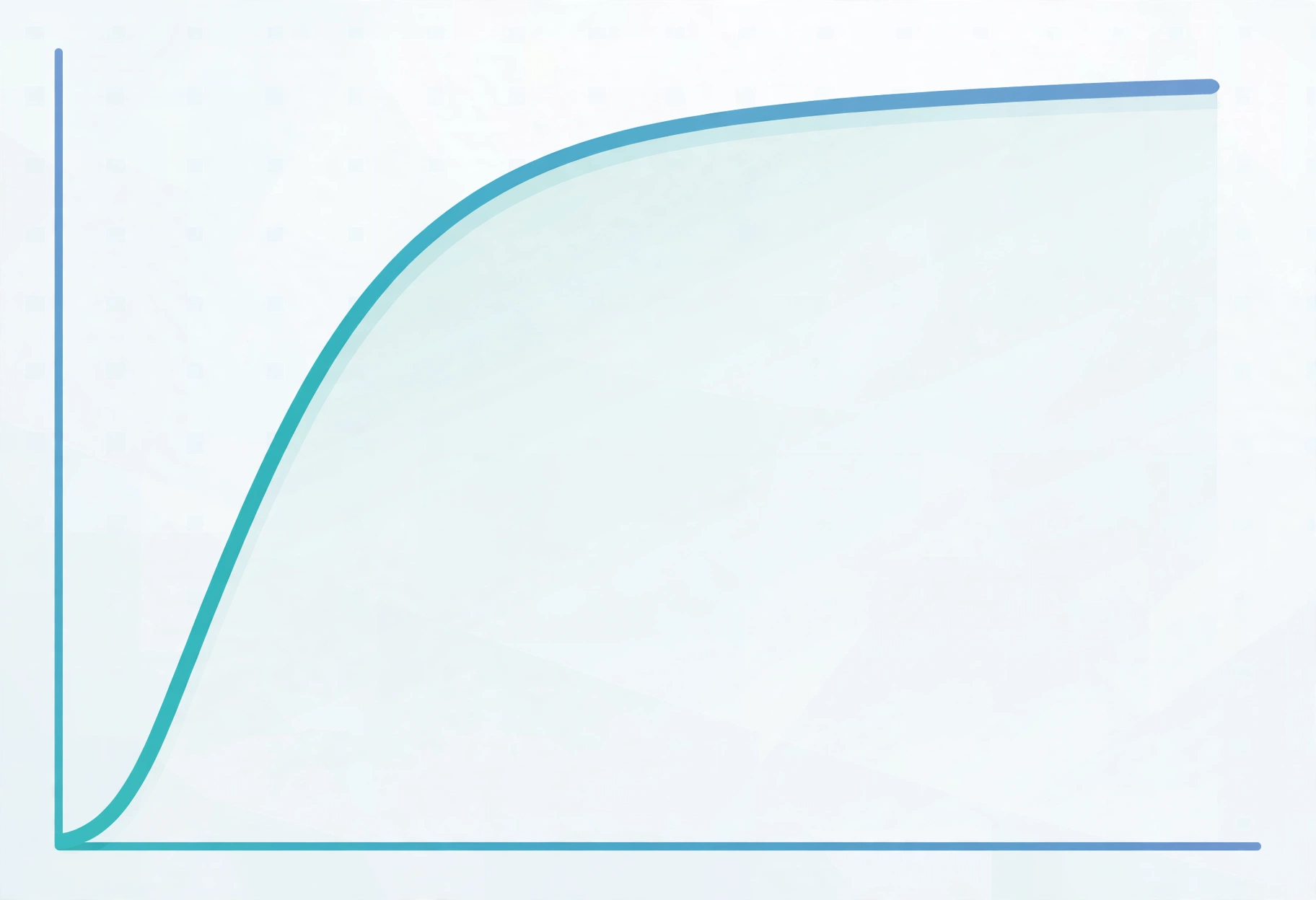
Fourth, the result is plotted on a logarithmic 0–100 curve. The logarithmic part matters enormously: moving from DR 10 to DR 20 is relatively easy, while moving from DR 70 to DR 80 requires a dramatically stronger backlink profile. The numerical gap looks identical, but the link-graph gap is not even close.
What Domain Rating Actually Measures (and What It Does Not)
Domain Rating measures exactly one thing: the strength of your backlink profile relative to every other site in Ahrefs’ index. It says nothing about your content quality, your traffic, your topical relevance, or how well you will rank.
This is worth internalizing because DR is often treated as a general “website quality score,” which it is not. A website can accumulate a high DR by being old, by being linked from other high-DR sites regardless of relevance, or even through spammy-but-effective link schemes that Ahrefs’ crawler has not discounted. DR tells you about link-graph position, full stop.
Equally important: DR is not a Google ranking factor. Google does not use Ahrefs’ metric in its algorithm — it cannot, since DR is a third-party calculation. Sites with strong, trustworthy link profiles (which DR approximates) do tend to perform well in search, but that is correlation, not causation. Use DR to spot likely strength, then confirm with real indicators: does the target page get organic traffic, is it topically relevant, and is the site actually alive and maintained?
One more nuance: DR only counts followed links. Links carrying rel="nofollow", rel="ugc", or rel="sponsored" do not count toward the calculation. Plenty of high-profile placements — Wikipedia references, many press mentions, most forum and comment links — are nofollow by policy. Claim them for traffic and brand visibility, but do not count them toward your DR plan.
Domain Rating vs Domain Authority: Key Differences
DR and DA get used interchangeably in casual conversation, but they are different metrics from different companies built on different data. Moz’s Domain Authority is the best-known alternative, and comparing the two side by side shows exactly where they diverge. Here is how they compare.
| Dimension | Ahrefs Domain Rating (DR) | Moz Domain Authority (DA) |
|---|---|---|
| Owner | Ahrefs | Moz |
| Scale | 0–100, logarithmic | 1–100, logarithmic |
| Primary inputs | Unique referring domains, their DR, outbound-link dilution | Link data plus spam-score signals and link-quality assessment |
| Nofollow handling | Excluded from the calculation | Counted in the underlying link graph, weighted differently |
| Content/traffic signals | None — purely link-based | None directly, but spam signals act as a quality proxy |
| Update behavior | Recomputed roughly daily as the crawler discovers links | Updated on Moz’s index refresh cycle |
| Manipulation resistance | Harder to game at scale due to outbound dilution | Historically more susceptible; Moz’s crawler sees a different slice of the web |
| Best used for | Quick link-profile strength comparison, prospect qualification | Relative ranking-potential estimate, competitive benchmarking |
Verdict: neither metric is “correct” — they answer slightly different questions. DR is the cleaner measure of raw link-graph strength, which is exactly why link builders quote it when qualifying prospects (“we only accept guest posts from DR 40+ sites”). DA tries to be a broader ranking-ability estimate. For day-to-day link building decisions, most practitioners check both and trust neither blindly. If you want the full breakdown, see our DA vs DR comparison.
Why Your Domain Rating Can Drop Without Losing a Single Link
One of the most confusing DR behaviors: your score falls even though you have not lost any backlinks. Nothing is broken — this is the scale “stretching.”
DR is relative, not absolute. It ranks your backlink profile against every other site in Ahrefs’ index of trillions of links. When other websites gain many backlinks, the entire distribution shifts. A site sitting at DR 100 cannot go higher, so when it gains more links the whole scale has to reshuffle to accommodate the increase — and everyone else’s position gets recalculated against the new curve.
Practically, this means two things. First, DR maintenance requires continuous link acquisition — standing still while competitors build links means slowly sliding backward. Second, small DR drops are usually noise, not a penalty or a lost-link crisis. Before panicking, check whether your referring-domain count actually changed in Ahrefs. If your links are intact and competitors simply outbuilt you, the fix is more links, not a forensic audit.
The reverse is also true and equally misleading: DR can rise without you doing anything, simply because linking domains in your profile gained authority themselves. Do not mistake a passive DR bump for link-building skill — and do not report it to a client as a win you engineered.

How to Check Your Domain Rating
The fastest free way is Ahrefs’ own Website Authority Checker — paste your domain and it returns DR plus referring-domain counts without an account. Inside a paid Ahrefs plan, DR appears in Site Explorer, and you can track it over time alongside referring domains to see whether score changes are driven by your link building or by scale reshuffling.
Third-party tools also display DR by licensing or estimating Ahrefs data, but the numbers can lag behind Ahrefs’ own index. If a prospect’s DR matters for a deal — say you are paying for a sponsored placement and the seller quotes DR 50 — verify it in Ahrefs directly before committing budget. Stale or inflated third-party DR figures are one of the most common ways buyers overpay for links.
For ongoing monitoring, export your referring domains monthly and watch two numbers side by side: unique referring domains and DR. When both rise together, your link building is working. When referring domains rise but DR stays flat, you are earning links from low-authority or heavily-diluted sources. When DR drops while referring domains hold steady, it is usually the scale stretching — check competitors before reacting.
How to Increase Your Domain Rating the Right Way
Because DR is purely link-based, increasing it comes down to earning followed links from unique, high-DR domains that do not link out to thousands of sites. There are no shortcuts in the formula — but some tactics are far more efficient than others.
Digital PR and data studies remain the highest-impact play: one original dataset can earn dozens of unique referring domains from news sites and blogs, many of them high-DR. Free tools and templates compound over time — a useful calculator keeps earning links for years after launch. Link reclamation converts unlinked brand mentions into followed links with a short outreach email. And broken link building lets you replace dead outbound links on relevant pages with your working resource.
What does not work well for DR: mass directory submissions (low DR, massive outbound dilution), blog-comment blasts (almost universally nofollow), and buying links from link farms (high risk, and Ahrefs’ dilution math specifically punishes sites that link to everyone). For a deeper playbook, read our guide on how to boost domain authority — the tactics overlap heavily since both metrics reward the same link-graph behaviors.
Set expectations honestly: DR moves on a weeks, not days timeline. Ahrefs recomputes roughly daily, but the lag is crawler discovery — it takes days to a few weeks for new placements to be found and factored in. A campaign that finishes on day 14 is often still paying out on day 35. Anyone promising DR jumps in 48 hours is selling something you should not buy.
Common Domain Rating Myths
Myth 1: “DR directly affects my Google rankings.” It does not. Google has never used Ahrefs’ metric. Strong link profiles correlate with rankings because links themselves matter to Google — DR is just one company’s way of scoring that profile.
Myth 2: “A higher DR site always outranks a lower DR site.” Topical relevance, content quality, and page-level factors routinely beat domain-level metrics. A DR 30 page that exactly matches search intent will outrank a DR 70 page that does not — this happens every day.
Myth 3: “I should only build links from sites with higher DR than mine.” Relevance and traffic matter as much as the number. A DR 25 link from a site in your exact niche, on a page that ranks and gets visits, routinely outperforms a DR 60 link from an unrelated general blog. DR is a filter, not a strategy.
Myth 4: “DR and DA should match.” They measure different things on different crawls with different formulas. A 15-point gap between your DR and DA is normal, not a sign that one tool is wrong.
Frequently Asked Questions
What is a good Domain Rating score?
It depends on your niche. For most small business and niche blog SERPs, DR 30–50 is competitive; for competitive commercial keywords, the top results often sit at DR 60+. Rather than chasing an absolute number, benchmark against the top 3 ranking pages for your target keyword — if they average DR 35, that is your realistic target zone.
Is Domain Rating the same as Domain Authority?
No. Domain Rating is Ahrefs’ metric (purely link-based); Domain Authority is Moz’s metric (link data plus spam and quality signals). They use different crawls, different formulas, and different scales of calibration — the same site will usually show different numbers, and that is expected.
Do nofollow links affect Domain Rating?
No. Ahrefs excludes nofollow, ugc, and sponsored links from the DR calculation. They can still drive referral traffic and brand visibility, but they will not move your DR number.
How long does it take to increase Domain Rating?
Expect weeks, not days. Ahrefs recomputes DR roughly daily, but new links must first be discovered by the crawler, which takes days to a few weeks per placement. Consistent link building typically shows DR movement within 4–8 weeks.
Can Domain Rating decrease without losing backlinks?
Yes. DR is relative to every other site in Ahrefs’ index, so when competitors gain backlinks the scale reshuffles and your score can dip even with your link profile intact. Check your referring-domain count before worrying — if it is stable, the drop is usually scale noise.
The Bottom Line on Ahrefs Domain Rating
Domain Rating is a useful, narrowly-defined number: the strength of your backlink profile as Ahrefs sees it, on a 0–100 logarithmic scale. Use it to qualify link prospects, benchmark competitors, and track link-building progress over time. Do not use it as a proxy for content quality, a Google ranking signal, or a vanity metric to chase at the expense of relevance. Build real links from real sites in your niche, and DR takes care of itself.
Done-for-you podcast backlinks
Get your brand on Apple Podcasts, Spotify, Amazon and 25 more trusted platforms — placed by hand, reported link by link.