
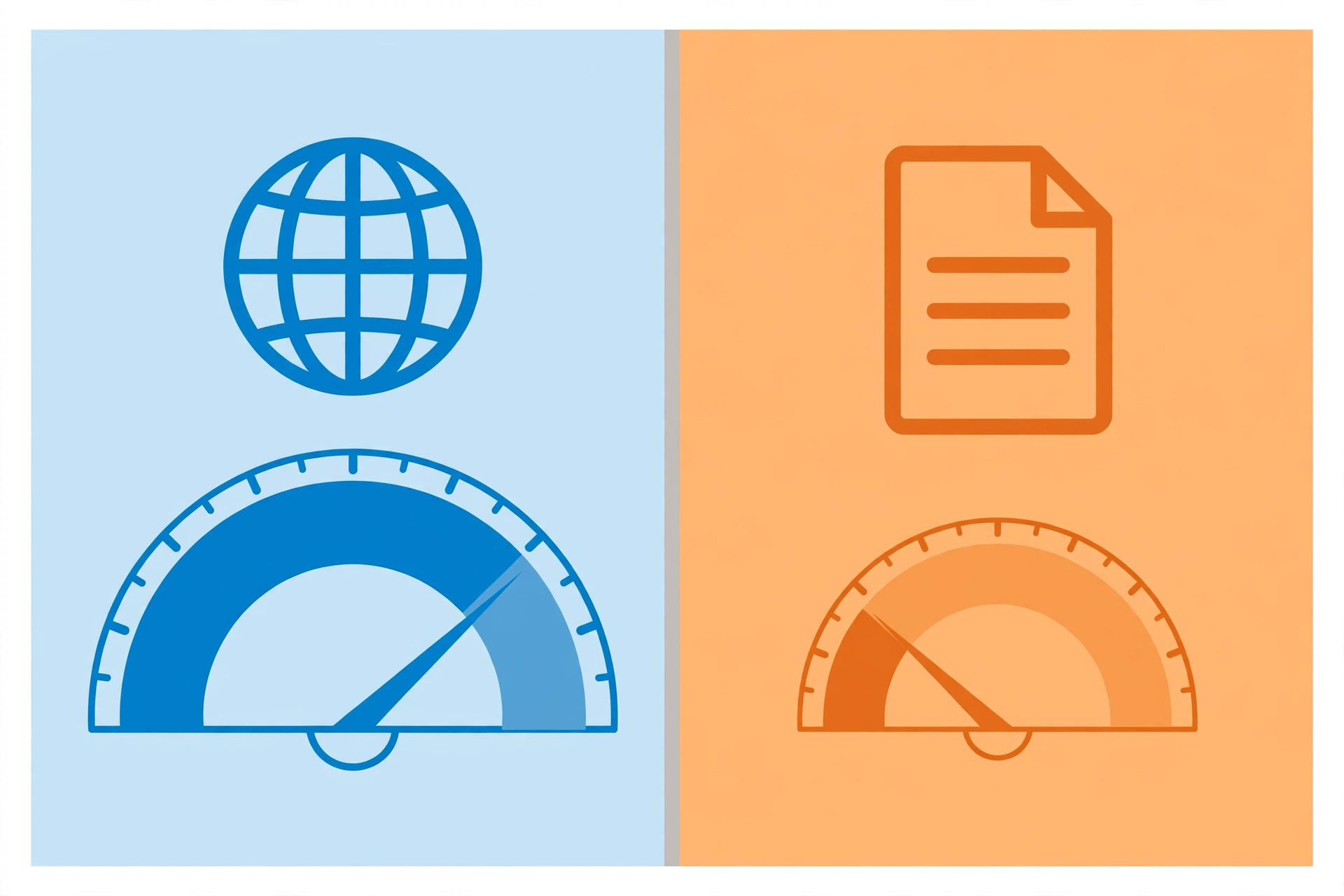
Domain Authority (DA) measures the ranking strength of an entire domain, while Page Authority (PA) measures the ranking strength of a single page. Both are 1-100 scores developed by Moz. Use DA to compare websites against each other, and PA to compare individual pages competing for the same keyword.
On this page
If you have ever checked a competitor’s metrics and wondered why their homepage outranks you despite having fewer backlinks, the answer usually lies in understanding the difference between domain authority vs page authority. These two numbers look similar, come from the same company, and use the same 1-100 scale — but they answer completely different questions. For a deeper breakdown of how DA works on its own, see our guide on what domain authority is and how it is calculated.
What Is Domain Authority?
Domain Authority is a search engine ranking score developed by Moz that predicts how likely an entire website is to rank in search engine result pages. It runs on a logarithmic 1-100 scale, which means it gets exponentially harder to climb as the number goes up. Moving from DA 20 to DA 30 takes far less effort than moving from DA 70 to DA 80.
Moz calculates DA using dozens of factors, with the link profile carrying the most weight. The two biggest inputs are the number of unique linking root domains and the total number of inbound links. A site with 500 links from 500 different domains will almost always outscore a site with 5,000 links from only 50 domains. Diversity of link sources matters more than raw link count.
Here is what makes DA genuinely useful: it lets you benchmark. When you are deciding whether a keyword is worth targeting, comparing your DA against the DA of pages already ranking tells you if the fight is fair. A DA 25 site going after a keyword dominated by DA 70+ sites is bringing a knife to a gunfight. That comparison is the single most practical use of the metric, and it is something no Google-provided tool offers directly.

What Is Page Authority?
Page Authority is Moz’s equivalent score for a single URL rather than a whole domain. It also runs on a 1-100 logarithmic scale and uses a similar machine-learning model, but every input is measured at the page level: links pointing directly to that page, the page’s own link profile quality, and page-level signals rather than domain-wide ones.
The critical thing to understand is that PA is page-specific. Your homepage might have a PA of 55 while a blog post published last week sits at PA 12. Same domain, wildly different scores. This happens because authority does not distribute evenly — the pages that attract the most direct links accumulate the most page-level strength, regardless of how strong the domain is overall.
PA shines in one specific scenario: page-to-page combat. When two pages compete for the same keyword, comparing their PA scores gives you a sharper read than comparing domain scores. A DA 60 site’s thin category page (PA 25) can absolutely lose to a DA 30 site’s flagship guide (PA 48) for a specific query. Google ranks pages, not websites — PA respects that reality in a way DA does not.

Domain Authority vs Page Authority: Key Differences
The table below breaks down every meaningful difference between the two metrics. Read the “when it matters” column carefully — that is where most SEOs go wrong, optimizing for the wrong number.
| Dimension | Domain Authority (DA) | Page Authority (PA) |
|---|---|---|
| Scope | Entire domain (all pages combined) | Single URL only |
| Scale | 1-100, logarithmic | 1-100, logarithmic |
| Developed by | Moz | Moz |
| Primary inputs | Linking root domains, total links, MozRank, MozTrust | Page-level links, page link quality, on-page factors |
| Update behavior | Changes slowly; reflects cumulative domain history | Can shift faster as individual pages gain or lose links |
| Best used for | Comparing websites; competitive benchmarking | Comparing specific pages targeting the same keyword |
| New page score | Inherits the domain’s DA immediately | Starts at PA 1; must earn its own links |
| Google ranking factor? | No — third-party prediction, not a Google signal | No — third-party prediction, not a Google signal |
| When it matters most | Deciding if a niche is winnable; prospecting link targets | Diagnosing why a specific page underperforms its rivals |
Verdict: Track both, but act on the one matching your question. Comparing sites? DA. Diagnosing a page? PA.
How Domain Authority Is Calculated
Moz has never published the exact formula, but they have confirmed the core ingredients. The DA model is trained with machine learning against actual search results: Moz feeds the algorithm thousands of ranking observations and lets it learn which link-profile features best predict ranking ability. The output is then normalized onto the 1-100 logarithmic scale.
The heaviest-weighted factors are linking root domains (how many unique websites link to you) and the quality of those domains. A single link from a high-authority editorial site can move the needle more than dozens of links from low-quality directories. Moz also folds in its proprietary MozRank (link popularity) and MozTrust (link trustworthiness, measured by distance from known-trusted seed sites) metrics.
One underappreciated detail: DA is relative, not absolute. Because the scale recalibrates as Moz’s link index grows, your DA can drop even if you did nothing wrong — simply because the overall web got more competitive or Moz crawled more of it. Do not panic over a 2-3 point fluctuation month to month. Worry only about sustained directional trends over quarters, and always compare against competitors measured at the same time. If everyone’s DA dropped 2 points, nothing actually changed.
For the full technical breakdown, Moz’s own documentation on how Domain Authority works is the authoritative source. Anything a third-party blog claims about the “exact formula” beyond that is speculation.
How Page Authority Is Calculated
Page Authority uses the same machine-learning approach as DA, but every signal is scoped to the individual page. The model looks at the quantity and quality of inbound links pointing directly at that URL, the authority of the linking pages (not just domains), and correlates those features against real ranking data for pages.
This page-level scoping creates dynamics that surprise people. Internal links matter enormously for PA: a deep blog post linked from your homepage and five category pages will carry meaningfully higher PA than an orphan page with the same number of external backlinks. Site architecture is a PA lever that costs nothing but planning. Most sites leave enormous PA on the table through flat or neglected internal linking.
PA also decays and recovers faster than DA. Lose the three best links pointing at a page and you may watch its PA slide within a reporting cycle, while the domain’s DA barely twitches. Conversely, a single strong editorial link to a specific guide can lift its PA several points in weeks. This responsiveness makes PA the better metric for measuring the impact of individual link-building campaigns — you can actually see which placements moved which pages.
Moz documents the methodology on their Page Authority explainer page. Note their explicit warning: like DA, PA is a comparative tool, not a Google ranking factor. Google has repeatedly confirmed it uses no such score.
When to Use DA vs PA: Practical Scenarios
Theory is nice; here is when each metric earns its keep in real workflows.
Use Domain Authority when you are choosing battles. Before committing three months to a content cluster, pull the DA of the top 10 ranking domains. If your DA 28 site faces a SERP where the weakest competitor is DA 55, that keyword is a wall — pick a longer-tail variant instead. DA is also the standard filter for link prospecting: most outreach lists set a minimum DA threshold (commonly 30+) to avoid wasting pitches on sites with no ranking power to pass.
Use Page Authority when you are diagnosing a specific URL. Your guide targets “best CRM for startups,” sits at position 14, and will not budge. Check the PA of the top 5 ranking pages versus yours. If theirs average PA 45 and yours is PA 22, the diagnosis is clear: that page needs dedicated links, not just “more domain authority” in the abstract. Build links to the page itself — guest posts, resource page placements, and digital PR pointing at that URL specifically.
Use both when evaluating a link opportunity. A outreach prospect shows DA 58 — looks great. But the actual page where your link would sit has PA 8 and zero organic traffic. That placement will pass far less value than the domain number suggests. The pro move is checking both: DA tells you the site is legitimate, PA tells you whether the specific page has any strength worth borrowing. If you want a systematic process for raising these numbers, our domain authority growth guide covers the tactics that move both metrics.
How to Improve Domain Authority and Page Authority
Neither score can be gamed directly — they are outputs, not inputs. You raise them by doing the things that earn the underlying signals: quality backlinks, at the right level of the site.
To raise Domain Authority, think in terms of referring domains. One link each from 50 relevant, legitimate websites beats 500 links from 5 sites. Digital PR campaigns, original data studies, and free tools are the most reliable engines for domain-diverse links because they give many different publishers an independent reason to cite you. Avoid link schemes entirely — a manual penalty will crater the real rankings that DA merely predicts.
To raise Page Authority for a specific URL, point links at that URL. This sounds obvious, yet most link builders default to homepage links out of habit. When you land a guest post, negotiate the target URL — a deep link to your money page builds its PA directly. Internally, audit which pages have the most PA (usually homepage and top categories) and redistribute some of it: add contextual internal links from those strong pages to the priority pages you want to rank. A concrete routine: once a month, open your top 10 pages by PA, and for each, add 2-3 internal links to the pages one tier below them in priority.
Track progress quarterly, not weekly. Both metrics move slowly, and week-to-week noise will only tempt you into reactive mistakes. Set a baseline today, execute for 90 days, then compare — and always compare against 3-5 named competitors measured in the same period, not against your own past in isolation.
Frequently Asked Questions
What is the difference between DA and PA?
Domain Authority scores an entire website’s ranking strength on a 1-100 scale, while Page Authority scores a single page’s ranking strength on the same scale. Both are developed by Moz. Use DA to compare websites and PA to compare individual pages competing for the same keyword.
Which is more important, Domain Authority or Page Authority?
Neither is universally more important — it depends on the question. DA matters more for competitive analysis and deciding which keywords are winnable. PA matters more when diagnosing why a specific page is not ranking. Google ranks pages, so for a single ranking battle, PA is the sharper metric.
Can a page have higher Page Authority than its Domain Authority?
Yes. A heavily linked individual page — for example, a viral blog post or flagship guide — can carry a PA well above its domain’s DA. This is common on newer sites where one standout piece attracted most of the site’s links while the rest of the domain is thin.
Is Domain Authority a Google ranking factor?
No. Google has confirmed it does not use Domain Authority or any Moz metric in its ranking systems. DA is a third-party prediction of ranking ability based on link data, useful for comparison but not something Google measures or rewards directly.
How often do DA and PA update?
Moz updates its link index and recalculates scores regularly, typically on a roughly monthly cycle. Do not expect day-to-day movement — meaningful changes show up over weeks to months as new links are discovered and factored into the model.
What is a good Domain Authority score?
There is no universal “good” score because DA is relative. A DA 30 site can dominate a niche where competitors sit at DA 20, while a DA 50 site can struggle in a space full of DA 80+ giants. Compare against the specific competitors ranking for your target keywords rather than chasing an absolute number.
Done-for-you podcast backlinks
Get your brand on Apple Podcasts, Spotify, Amazon and 25 more trusted platforms — placed by hand, reported link by link.