
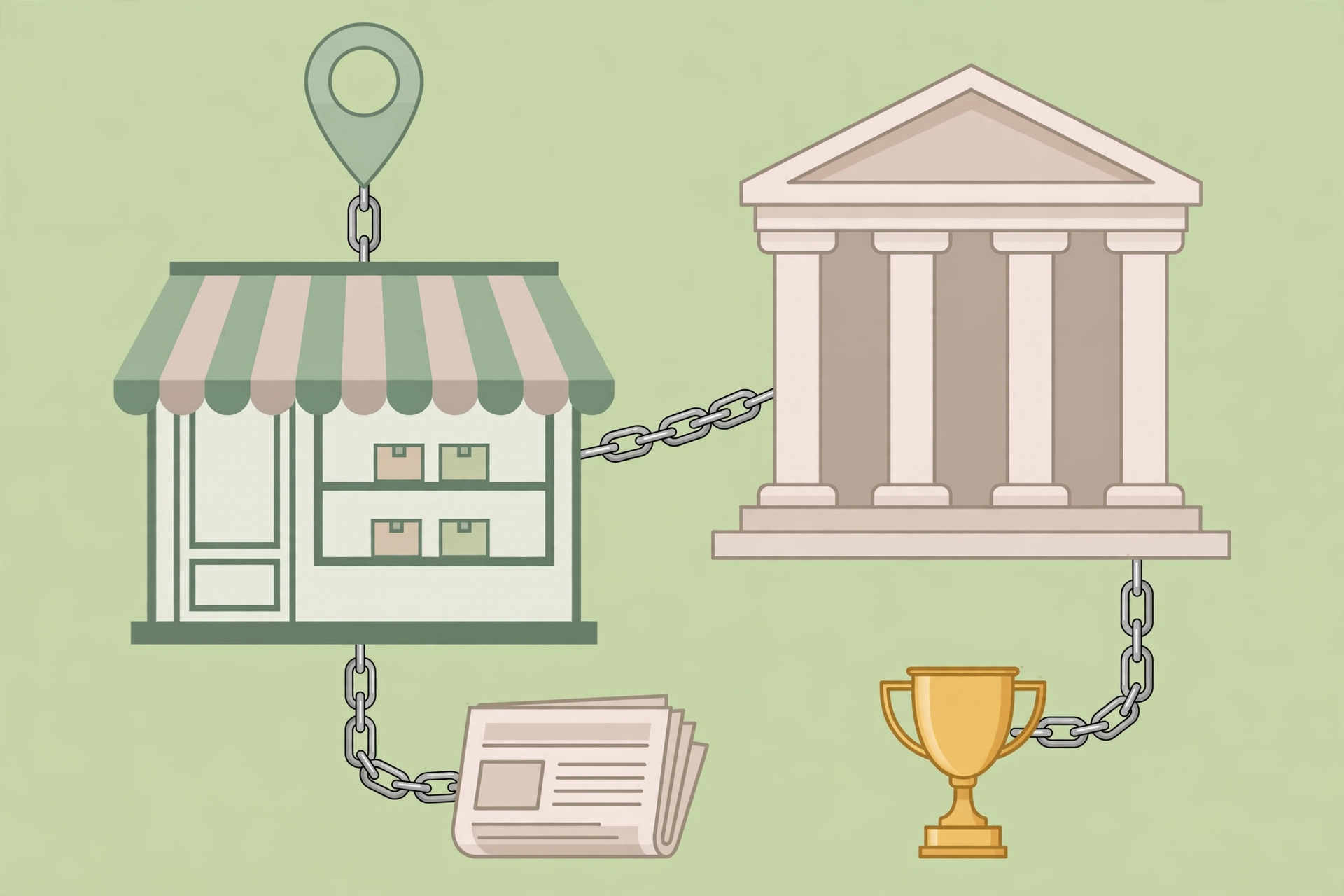
Local SEO for small business means optimizing your Google Business Profile, website, and review presence so nearby customers find you before they find your competitors. Claim and fully complete your Business Profile, collect reviews on a steady schedule, keep your name, address, and phone number identical everywhere online, and build pages that target “[service] in [city]” searches.
On this page
- How Google Decides Which Local Businesses Rank
- Target Local Keywords on Every Key Page
- Claim and Optimize Your Google Business Profile
- Build a Review Engine That Runs on Autopilot
- Keep Your NAP Identical Everywhere
- Build Location Pages That Earn Their Rankings
- Earn Local Links Without Chasing Them
- Local SEO for Small Business: The 90-Day Playbook
- Track the Numbers That Actually Matter
- Frequently Asked Questions
This is not a theory article. It is a playbook: the exact sequence a small business should follow, what to skip, and how long each part takes. Follow it in order and you will cover everything that actually moves local rankings — without hiring an agency.
How Google Decides Which Local Businesses Rank
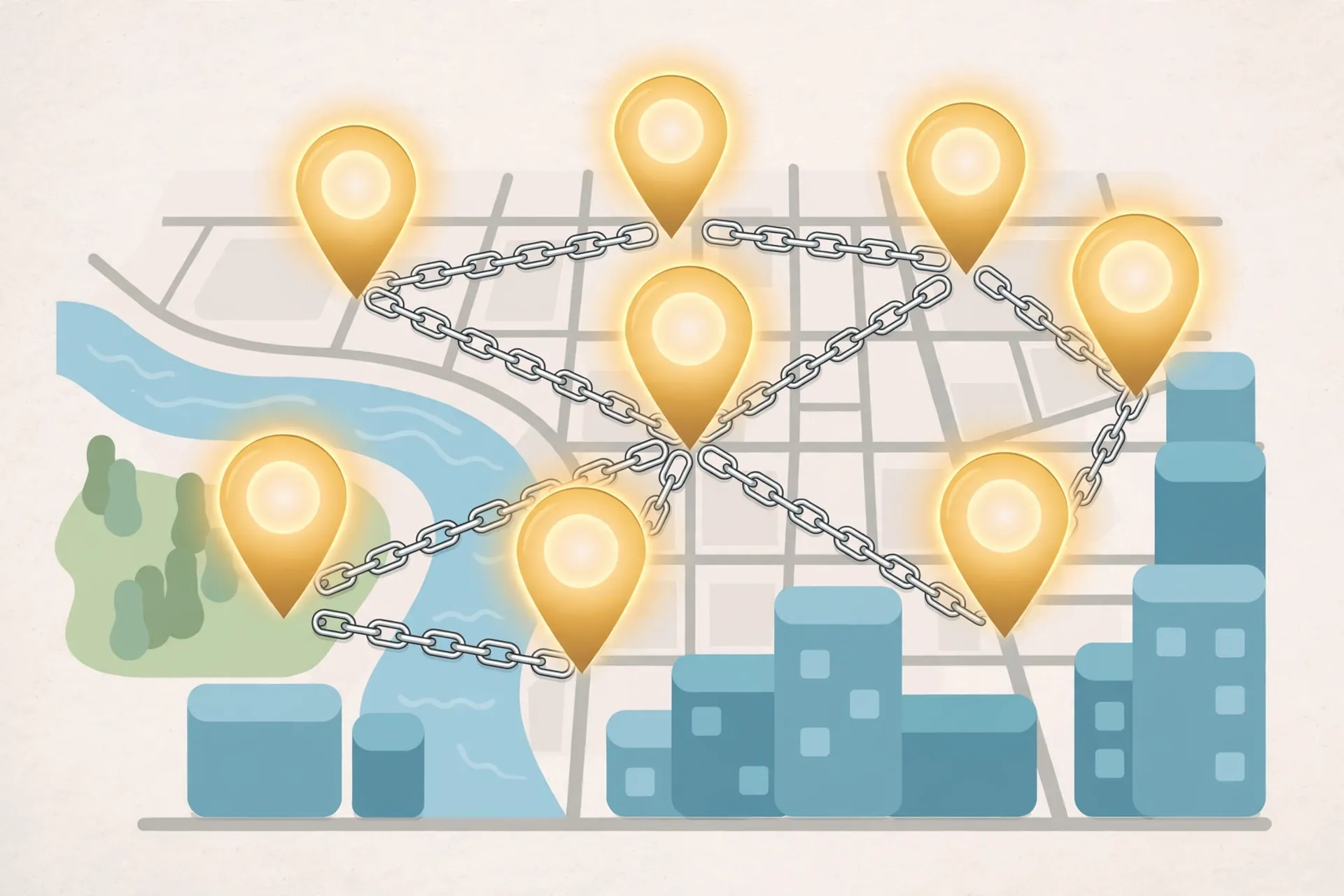
When someone searches “plumber near me,” Google does not just rank websites — it ranks businesses against three things: relevance (how well your listing matches the search), distance (how close you are to the searcher), and prominence (how well-known and trusted your business appears online). These are Google’s own stated local ranking factors, and the whole playbook below maps to them.
You cannot change your distance from a searcher, and relevance is mostly a matter of complete, accurate information. That leaves prominence as your main lever — and prominence is built from reviews, citations, and links from other local websites. A handful of links from real local sites beats dozens of random directory submissions every time.
The “map pack” — those three business listings with the map at the top of local results — is where nearly all the clicks go. Everything in this playbook is aimed at winning a spot there.
Target Local Keywords on Every Key Page
Local keyword targeting is simpler than national SEO. Your customers search in a predictable pattern: [service] + [city]. “Emergency plumber Austin.” “Wedding photographer Denver.” “Best tacos near me.” Your job is to make it unmistakable to Google which searches each of your pages should win.
Put the pattern to work:
- Your homepage title tag should carry your main service plus city: “Emergency Plumber in Austin | Joe’s Plumbing.”
- Each core service gets its own page, with the same pattern in the title tag and H1.
- Write like a local: mention neighborhoods, landmarks, and the areas you serve. “Serving Round Rock, Cedar Park, and Georgetown” tells Google — and humans — exactly where you operate.
- When local sites link to you, the clickable words matter. Descriptive anchor text like “Austin emergency plumber” tells Google what you do; repeating your business name everywhere wastes the signal.
Concrete example: a bakery in Austin should not chase “best bakery” nationally. It should own “custom birthday cakes Austin,” “wedding cakes Round Rock,” and “gluten-free bakery near me” — searches with clear buying intent from people who can actually walk through the door.
Claim and Optimize Your Google Business Profile
Your Google Business Profile is the single most important local SEO asset you own. It powers the map pack, the knowledge panel, and the review stars searchers see before they ever visit your website. If you do nothing else in this guide, do this section properly.
- Claim and verify the listing. Google’s verification guide walks through the options; postcard verification still takes several days, so start this first.
- Pick the most accurate primary category (“Plumber,” not “Home Services”) and add relevant secondary categories.
- Fill every field: hours including holiday hours, services with descriptions, service areas, and business attributes.
- Upload real photos — storefront, team, work in progress. Listings with genuine photos earn noticeably more engagement than bare ones.
- Publish a profile post weekly: an offer, an event, or a new service. It keeps the listing looking alive.
- Seed the Questions section with the questions customers actually ask, then answer them yourself before strangers do.
The most common mistake is claiming the profile and never touching it again. Google favors active, complete profiles — revisit yours monthly and treat it like a second homepage.
Build a Review Engine That Runs on Autopilot
Reviews are the most visible trust signal in local search. Searchers read them before calling, and Google’s own guidance lists reviews among the signals shaping local visibility. The businesses that win are rarely the ones with a perfect 5.0 — they are the ones with a steady flow of recent reviews. For the full picture of how reviews feed into prominence, Moz’s local SEO guide is a solid deeper read.
Build the engine once, then let it run:
- Ask every customer, every time. The best moment is right after a successful job, while the goodwill is fresh.
- Make it frictionless: a short link or QR code that opens your Google review form directly. Put it on receipts, invoices, and follow-up texts.
- Use a script so staff actually do it: “Thanks for choosing [Business]! If we earned it, a quick Google review helps our small business more than you know: [link]”
- Respond to every review within 48 hours — the good ones with specifics (“Glad the water heater install went smoothly, Sarah!”), the bad ones calmly and without defensiveness. A thoughtful reply to a negative review convinces more future customers than the review itself repels.
- Never buy reviews or offer incentives for positive ones. Google removes fake reviews in waves, and a sudden purge can gut your rating overnight.
Keep Your NAP Identical Everywhere
NAP — name, address, phone number — is the boring foundation everything else sits on. When Google sees “Joe’s Plumbing” on your site, “Joe’s Plumbing LLC” on Yelp, and a different phone number on Facebook, its confidence in your business drops. Inconsistent citations quietly dilute the trust you built everywhere else.
The fix is mechanical:
- Decide on one canonical version of your name, address, and phone number. Write it down and never improvise.
- Update the big platforms first: Google Business Profile, Apple Business Connect, Bing Places, Yelp, and Facebook.
- Then work through industry directories — HomeAdvisor for contractors, Avvo for lawyers, Healthgrades for clinics.
- Search your business name plus city once a month and fix anything that drifted.
This is unglamorous work, and that is exactly why most of your competitors skip it. Consistency compounds.
Build Location Pages That Earn Their Rankings
If you serve multiple areas, each one deserves its own page — but only if the page is genuinely useful. A location page that swaps the city name on otherwise identical text is thin content, and Google treats it that way.
A location page that ranks has:
- Unique content about that area: neighborhoods served, local projects completed, area-specific FAQs.
- An embedded map and clear contact info with the local phone number.
- LocalBusiness schema markup telling Google exactly what and where the business is — Google’s LocalBusiness structured data documentation lists the required fields.
- Links from your homepage and service pages using the city name in the anchor text. A flat site where location pages hang off the navigation with no internal links rarely ranks — build a strong internal linking structure and give each page a clear path from pages that already carry authority.
One strong location page beats five thin ones. Start with your most valuable service area and expand only when the first page earns traffic.
Earn Local Links Without Chasing Them
Local links — links from websites in your community — feed directly into prominence, and they are the one ranking input your national competitors cannot easily replicate. Think chamber of commerce, local news sites, event pages, neighborhood blogs, and businesses you partner with.

You do not need dozens of them. A realistic starter set: join the chamber of commerce, sponsor one local team or event per year, partner with two or three complementary businesses (the plumber recommends the electrician and vice versa), and pitch one genuinely newsworthy story to the local paper each year. For the complete tactics list, our in-depth guide to local link building goes deep — this playbook just needs you to start the habit.
Local SEO for Small Business: The 90-Day Playbook
Here is the whole sequence in one view. Do the rows in order — each one builds on the last, and skipping ahead is why most DIY efforts stall.
| Phase | Timeframe | Focus | Key actions |
|---|---|---|---|
| Foundation | Weeks 1–2 | Profile and NAP | Claim and verify GBP; complete every field; standardize NAP; fix top 10 citations |
| Momentum | Weeks 3–6 | Reviews and keywords | Launch the review request system; retitle homepage and service pages for “[service] in [city]” |
| Authority | Months 2–3 | Content and links | Publish the first location page; earn 3–5 local links; post weekly on GBP |
| Compound | Month 3+ | Measure and repeat | Review GBP insights; double down on what drove calls; expand to the next service area |
Most small businesses that follow this order see map-pack movement inside the 90-day window. The ones that stall almost always skipped the foundation rows.
Track the Numbers That Actually Matter
Ignore vanity metrics for the first quarter. Three numbers tell you whether the playbook is working:
- Map pack position for 5–10 core “[service] in [city]” keywords, checked weekly from inside your service area. Rankings checked from across the country mean nothing for local.
- GBP insights: calls, direction requests, and website clicks. These are the actions that turn into revenue.
- Search Console queries containing your city name — growing impressions here mean Google is associating you with the area.
If calls and direction requests climb while rankings wobble, you are still winning. Rankings are the means; the phone ringing is the goal.
Frequently Asked Questions
How long does local SEO take for a small business?
Plan for three to six months of consistent work before judging results. Quick wins — verifying your profile, fixing hours, correcting NAP errors — can show movement within weeks, but competitive markets and brand-new profiles take longer. Anyone promising page-one map pack placement in 30 days is selling something, not a strategy.
How much does local SEO cost for a small business?
Done yourself, it costs time rather than money: Google Business Profile, Apple Business Connect, and Bing Places are all free, and this playbook needs no paid tools. Agencies typically charge anywhere from a few hundred to a few thousand dollars per month depending on market and location count. Start with the DIY playbook above; hire help only when you have multiple locations or a fiercely competitive market.
Can I do local SEO myself, or do I need an agency?
Yes, you can do it yourself if you stay consistent — a few focused hours a month on your Business Profile, reviews, and citations covers the majority of what moves rankings. The work is not technically difficult; the discipline of doing it every month is what separates businesses that rank from those that stall. Bring in help when you expand to multiple locations or compete in a saturated market like legal or home services in a big city.
What is the difference between local SEO and regular SEO?
Regular SEO targets broad keywords for a national or global audience. Local SEO targets “[service] in [city]” searches and the map pack, using tactics regular SEO never touches: Google Business Profile optimization, review management, NAP consistency across directories, and location pages. If your customers come from a defined geographic area, local SEO is the higher-priority — and usually higher-ROI — investment.
Do I need a website if I already have a Google Business Profile?
Yes. Your profile gets you into the map, but your website gives Google more reasons to trust you, lets you rank for far more searches through service and location pages, and is where customers check your prices, past work, and credibility before they call. Businesses with a solid website behind their profile consistently outperform profile-only competitors.
Done-for-you podcast backlinks
Get your brand on Apple Podcasts, Spotify, Amazon and 25 more trusted platforms — placed by hand, reported link by link.