
A local citation audit is a check of every place your business name, address, and phone number (NAP) appear online. Inconsistent NAP data confuses Google and quietly suppresses your local pack rankings, so this local citation audit guide walks you through the four phases: inventory citations, verify NAP accuracy, find duplicates and gaps, then clean up your local SEO footprint the right way.
On this page
What Is a Local Citation Audit?
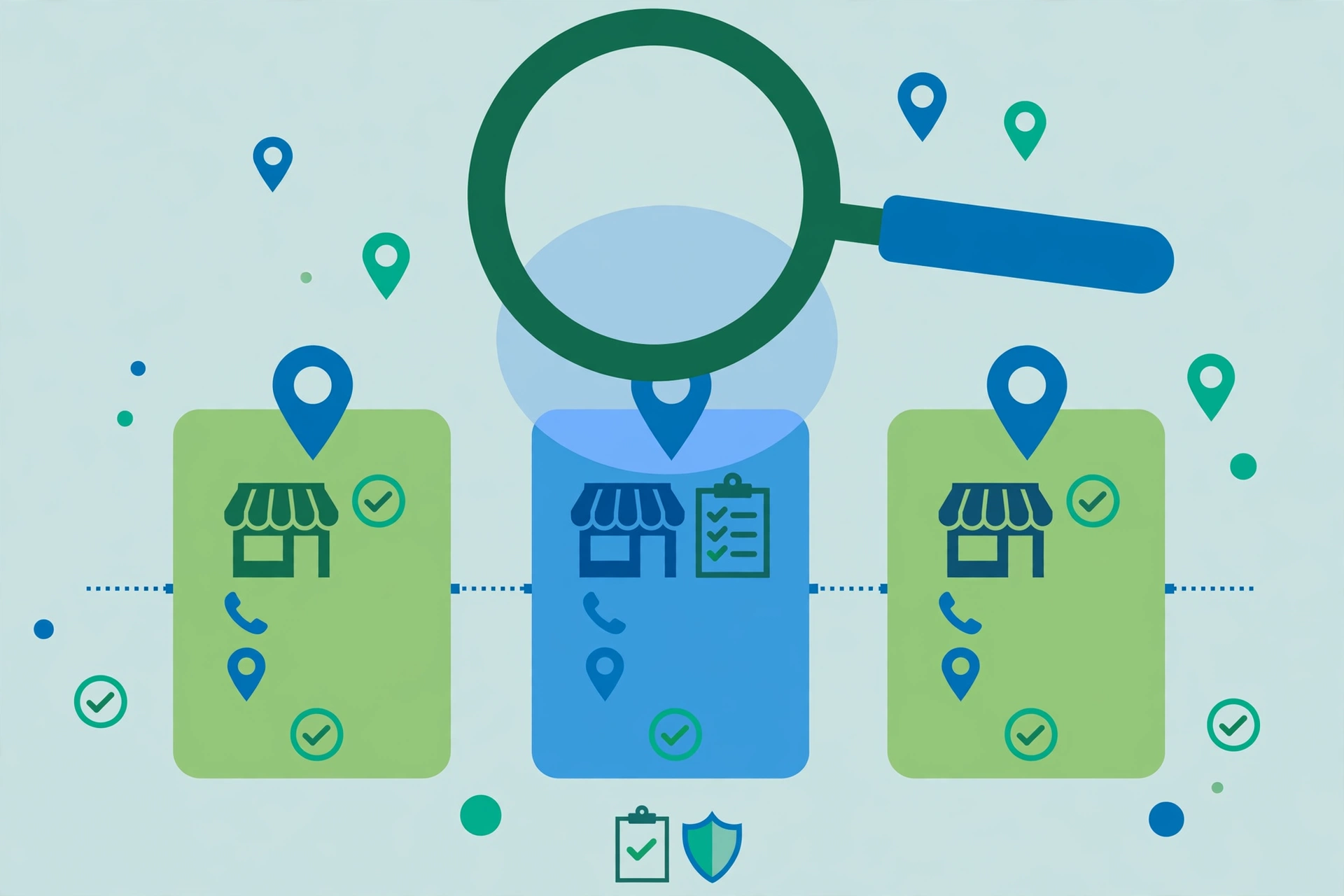
A local citation audit is a structured review of all your business’s online listings to find incorrect, inconsistent, or duplicate information. It answers one question: does the internet agree on who you are, where you are, and how to reach you?
Definition: A Systematic Check of Every Place Your NAP Appears
NAP stands for Name, Address, Phone number — the three core identity fields Google uses to verify a local business, usually plus your website URL and business hours. A citation is any online mention of your NAP, whether or not it links to your site: your Google Business Profile, a Yelp listing, a chamber-of-commerce directory entry, even an old Yellow Pages page that still ranks. The audit inventories all of them and checks each against your canonical business information.
Citations = Directories, Aggregators, Review Sites, Social Profiles — the full inventory a local citation audit must cover, Industry Listings
Citations live in five main places. Data aggregators (the big suppliers that feed hundreds of smaller directories downstream) are the highest-leverage. Major directories — Google Business Profile, Bing Places, Apple Maps, Yelp, Facebook — are what customers actually see. Review sites like TripAdvisor or industry-specific review platforms carry your NAP alongside ratings. Social profiles (LinkedIn, Instagram business profiles) often hold outdated addresses nobody thinks to update. And industry listings — legal directories for lawyers, health directories for clinics — are frequently the ones your competitors rank on and you are missing.
Audit First, Build Second — the golden rule of local citation audit work
The most common mistake in local SEO is building new citations on a broken foundation. If your business moved two years ago and 30 directories still show the old address, adding 20 more citations just multiplies the confusion — half the internet will now “confirm” the wrong location. Always audit and clean up first, then build. New citations amplify whatever NAP they copy, so make sure the source of truth is correct before you scale.
Why NAP Consistency Matters for Local Rankings
Google does not simply trust what you claim on your Google Business Profile. It cross-references your NAP against dozens of independent sources to verify that your business is real and located where you say it is. When those sources agree, confidence rises and rankings follow. When they conflict, Google hedges — and hedging means lower local pack placement.
Google Cross-References Citations to Verify Your Business — the ranking mechanism behind every local citation audit
Think of citations as votes of confidence in your business’s identity. Each consistent listing is one more independent source confirming the same name, address, and phone. This verification layer is especially important for newer businesses and for competitive categories where Google needs tiebreakers between similar profiles. Moz’s local listings guide explains how this trust-building mechanism fits into the broader local ranking factors.
Conflicting Addresses and Phones Dilute Trust; Duplicates Split Authority
Inconsistency does not just fail to help — it actively hurts. An old suite number on twenty directories, a phone number with a transposed digit, a business name spelled three different ways: each conflict gives Google a reason to doubt your listing. Duplicates are equally damaging. Two Google Business Profiles for the same location split your reviews and ranking signals between them instead of concentrating them on one strong profile. Ahrefs’ research on local citations confirms that cleanup of duplicates and inconsistencies is among the highest-ROI local SEO actions.
Impact Areas: Local Pack, Business Profile Strength, Voice Search
NAP consistency feeds three visible outcomes. The local pack — the map with three businesses Google shows for local queries — is the most competitive and the most sensitive to citation trust. Your Google Business Profile’s overall strength, including its eligibility for features like booking buttons and product listings, rests partly on verified identity. And voice search answers (“find a plumber near me”) pull from the same verified business data — inconsistent NAP can make you invisible to assistants even when you rank in traditional results.
The classic silent killer: one wrong suite number across 20 directories. It looks trivial, but it is exactly the kind of discrepancy that erodes Google’s confidence listing by listing. And the number-one audit finding across local SEO work is an old address lingering after a move — businesses update their website and Google profile, then forget the dozens of directories scraped years earlier.
Inventory Every Citation
Before fixing anything, build the complete inventory. You cannot clean up what you have not found.
Search Google for Your Business Name + Phone, Name + Address
Start with manual searches: "Your Business Name" + "your phone number", then "Your Business Name" + "your address". Crucially, repeat these searches with old variants — previous business names, old phone numbers, and former addresses. Legacy data persists for years on scraper sites, and the listings you forgot about are usually the ones with wrong information. Search without quotes too, since some directories mangle your name in ways exact-match searches miss.
Check the Big Aggregators and Directories
Work through the high-impact platforms directly: Google Business Profile, Bing Places, Apple Maps, Yelp, and Facebook. Claim or locate your listing on each and record the URL. These five are the listings customers actually encounter and the ones Google weights most heavily — getting them right covers the majority of your citation value.
Build the Tracking Spreadsheet
Create a spreadsheet with these columns: Platform | Listing URL | Business name as shown | Address as shown | Phone as shown | Hours | Categories | Claimed? (Y/N) | Status (correct / wrong / duplicate / missing). Every citation you find gets one row. This spreadsheet becomes your audit deliverable and your ongoing maintenance log — for agencies, it is also the client-ready artifact that justifies the work. Fill it completely before moving to NAP verification; auditing against an incomplete inventory produces false confidence.
Verify NAP Accuracy on Each Listing
With the inventory built, verify each row against your canonical business information.
The Canonical NAP: Pick ONE Exact Format and Document It
This is the single most important deliverable of the entire audit: a canonical NAP document — one exact, character-for-character format for your business name, street address, and phone number. Decide once: “St” or “Street”? Suite notation — “Suite 200”, “Ste 200”, or “#200”? Local area-code number or toll-free? Write it down, store it where anyone who touches your listings can find it, and every future listing copies it exactly. Most NAP inconsistency is not caused by errors — it is caused by five well-meaning people each writing the address slightly differently.
Check: Name Spelling, Address, Phone, Hours, Categories, Website URL
For each listing, verify the full set: business name spelling (including LLC/Inc suffixes — pick one), complete street address, the local phone number customers actually call (not just a toll-free line), current business hours, correct primary and secondary categories, and the website URL pointing to the right location page. A wrong category (“plumber” listed as “general contractor”) or a URL pointing to the homepage instead of the location page are quiet ranking leaks.
Flag: Wrong Info, Duplicates, Unclaimed Listings, Closed Locations
Mark every row with one of four flags: wrong info (needs an edit), duplicate (same business listed twice on one platform — needs a merge or removal), unclaimed (exists but you do not control it — needs claiming), or closed location (a shut branch still listed — needs marking permanently closed, never deleted outright, since deletion can orphan its reviews). Google’s own guidance on managing business information covers the correct workflows for edits, merges, and closures.

Find Duplicates and Missing Citations
With accuracy verified, hunt for structural problems: listings that should not exist, and listings that should exist but do not.
Duplicates: Claim and Merge, Don’t Just Ignore
Duplicates commonly come from staff creating listings independently over the years — the marketing intern made a Yelp page in 2021, the franchise owner made another in 2023. On each platform, claim both listings first (you usually need control of a listing to merge or remove it), then use the platform’s merge or “suggest an edit → permanently closed/duplicate” flow. Centralize listing ownership going forward: one person or one documented process creates listings, nobody else.
Missing: Compare Against Top-Ranking Competitors’ Citation Profiles
Pull up the three businesses outranking you in the local pack and check where they are listed that you are not. This is the local equivalent of a backlink gap analysis guide: the directories your winning competitors share are, by revealed preference, the citations that matter in your market. If all three top plumbers are on the same trade directory and you are not, that is your next submission — not another generic directory nobody in your industry uses.
Industry-Specific Directories Outweigh Generic Ones
A listing on the directory your industry actually uses — the bar association directory, the medical board finder, the trade association member list — carries more weight than ten generic directories. These niche listings are topically relevant, frequently crawled, and often the exact pages customers visit. Prioritize them over bulk directory submissions every time.
Clean Up Errors and Build New Citations
Now execute — in the right order, because sequence matters for how fast fixes propagate. This execution phase is where a local citation audit turns findings into ranking movement:
Fix in Priority Order: Google Business Profile First
Work top-down by impact: 1. Google Business Profile — your most visible listing and Google’s primary source. 2. Data aggregators — correcting at the source propagates fixes to hundreds of downstream directories automatically. 3. Major directories — Yelp, Bing, Apple, Facebook. 4. Niche and industry directories. Fixing a downstream directory before its upstream aggregator is corrected just means the aggregator will overwrite your fix on its next data push.
Claim Unclaimed Listings Before Editing
Always claim a listing before attempting to correct it. Editing an unclaimed listing through “suggest an edit” puts you in a moderation queue behind whoever actually controls it — and if a competitor or a scraper claimed it first, your edits may never apply. Claiming establishes you as the authoritative owner; then your corrections stick and future edit suggestions from strangers get routed to you for approval.
How to Build Local Citations (The Right Way)
Once cleanup is done, build deliberately: submit manually to 15–20 core directories first, then 5–10 niche or industry-specific ones. Manual submission beats automated every time for accuracy — bulk submission tools are how inconsistent NAP gets created in the first place. Never buy bulk citation blasts from services promising “500 citations for $29”: they create listings on junk directories, use inconsistent formatting, and leave you with an unmaintainable mess. Twenty accurate citations beat two hundred sloppy ones.
Correct at the Aggregator Source So Fixes Propagate Downstream
Data aggregators supply business data to hundreds of smaller directories, apps, and voice assistants. A correction made at the aggregator level flows downstream over 2–6 weeks; a correction made only on a downstream directory gets overwritten the next time the aggregator pushes its (still wrong) data. This is why aggregators sit at step two of the priority order — they are the multiplier for everything below them.
Citation Audit Tools and Maintenance Schedule
The right local citation audit tooling depends on your scale — and honest guidance here saves single-location businesses from buying software they do not need.
Free: The Manual Spreadsheet Method
Everything in this guide — the searches, the spreadsheet, the platform-by-platform verification — is the free method, and for a single-location business it is genuinely sufficient. The native dashboards (Google Business Profile manager, Bing Places, Apple Business Connect) give you direct control of your most important listings at no cost. Pair the audit with a general free SEO audit to catch the on-site local signals (location pages, schema, NAP in the footer) that citations alone do not cover.
Paid: BrightLocal, Whitespark, Moz Local
Paid tools earn their keep at scale. BrightLocal and Whitespark automate citation tracking, find inconsistencies across hundreds of sources, and monitor for new duplicates appearing. Moz Local pushes corrections to aggregators and directories from one dashboard. The honest threshold: if you manage 5+ locations, the manual method breaks down and software pays for itself. Below that, it is a convenience, not a necessity.
Maintenance: Quarterly Quick-Check, Full Audit Annually
Citations decay — directories get scraped, staff make well-meaning edits, aggregators push stale data. Run a quick quarterly check of your top 10 listings — the maintenance cadence that keeps a local citation audit from going stale (takes under an hour), and a full audit annually or immediately after any business move, rebrand, or phone number change. After a move especially, expect the cleanup to take 2–6 weeks for aggregator corrections to propagate fully downstream — plan the move’s SEO timeline around that, not after it.
A local citation audit is never one-and-done: citations decay, directories get scraped, and aggregators push stale data. For the deeper local ranking mechanics behind everything here — proximity, relevance, prominence, and how citations fit among them — see Search Engine Journal’s local SEO guide.
Done-for-you podcast backlinks
Get your brand on Apple Podcasts, Spotify, Amazon and 25 more trusted platforms — placed by hand, reported link by link.