

Ecommerce SEO fails in predictable ways: thousands of near-duplicate product pages, category pages with no unique content, and faceted navigation spawning infinite URLs. This guide covers the full ecommerce SEO best practices system for 2026 — architecture, keyword strategy, page-level optimization, and the internal linking discipline that holds it all together.
On this page
- What Makes Ecommerce SEO Different?
- Keyword Strategy for Online Stores
- Site Architecture Best Practices
- Product and Category Page SEO Best Practices
- Technical Ecommerce SEO Essentials
- Shopify SEO Best Practices (Platform-Specific)
- Content Marketing for Ecommerce SEO
- Ecommerce SEO for AI Search and Video
- Common Ecommerce SEO Mistakes
- Measuring Ecommerce SEO: KPIs That Actually Matter
- The Bottom Line
What Makes Ecommerce SEO Different?
Four structural challenges separate store SEO from content-site SEO — and ecommerce SEO best practices are the system for handling all four:
- Scale. A blog manages dozens of pages; a store manages thousands of near-identical SKUs. Every SEO task — titles, descriptions, internal links — must work through templates and systems, not page-by-page effort.
- Thin content. Manufacturer descriptions get pasted across hundreds of stores. Google sees the same paragraph on 200 domains and ranks none of them well. Unique content is the differentiator.
- Faceted navigation. Color, size, price, and brand filters generate exponential URL combinations. Uncontrolled, they create crawl bloat, duplicate content, and diluted link equity.
- The category-vs-product split. Category pages target broad head terms; product pages target specific long-tail terms. When both chase the same keyword, they cannibalize each other and neither ranks.
The frame for everything below: ecommerce SEO is technical SEO plus content discipline at scale. Get the architecture right once, and thousands of pages benefit. Get it wrong, and no amount of blogging fixes it.
Keyword Strategy for Online Stores
One of the highest-leverage ecommerce SEO best practices: map one keyword per page template and enforce it ruthlessly:
- Category pages target head terms: “running shoes”, “espresso machines”. These are your money pages for high-volume searches.
- Product pages target specific terms: “Nike Air Zoom Pegasus 40”, “Breville Barista Express”. Long-tail, high intent, closer to purchase.
- Blog content targets informational terms: “how to choose running shoes”, “espresso vs drip coffee”. These capture research-stage traffic and earn links.
The cardinal rule: never let a product page and its parent category target the same keyword. When they do, Google cannot decide which to rank, and both underperform. Audit quarterly.
Go one level deeper with search intent per template. Category pages serve commercial-investigation intent (“best espresso machines under $500”) — shoppers comparing options. Product pages serve transactional intent (“buy Breville Barista Express”) — shoppers ready to convert. Your category copy should compare and guide; your product copy should reassure and close. When a category page reads like a product pitch or a product page reads like a buying guide, intent is mismatched and conversions suffer even if rankings hold.
Site Architecture Best Practices
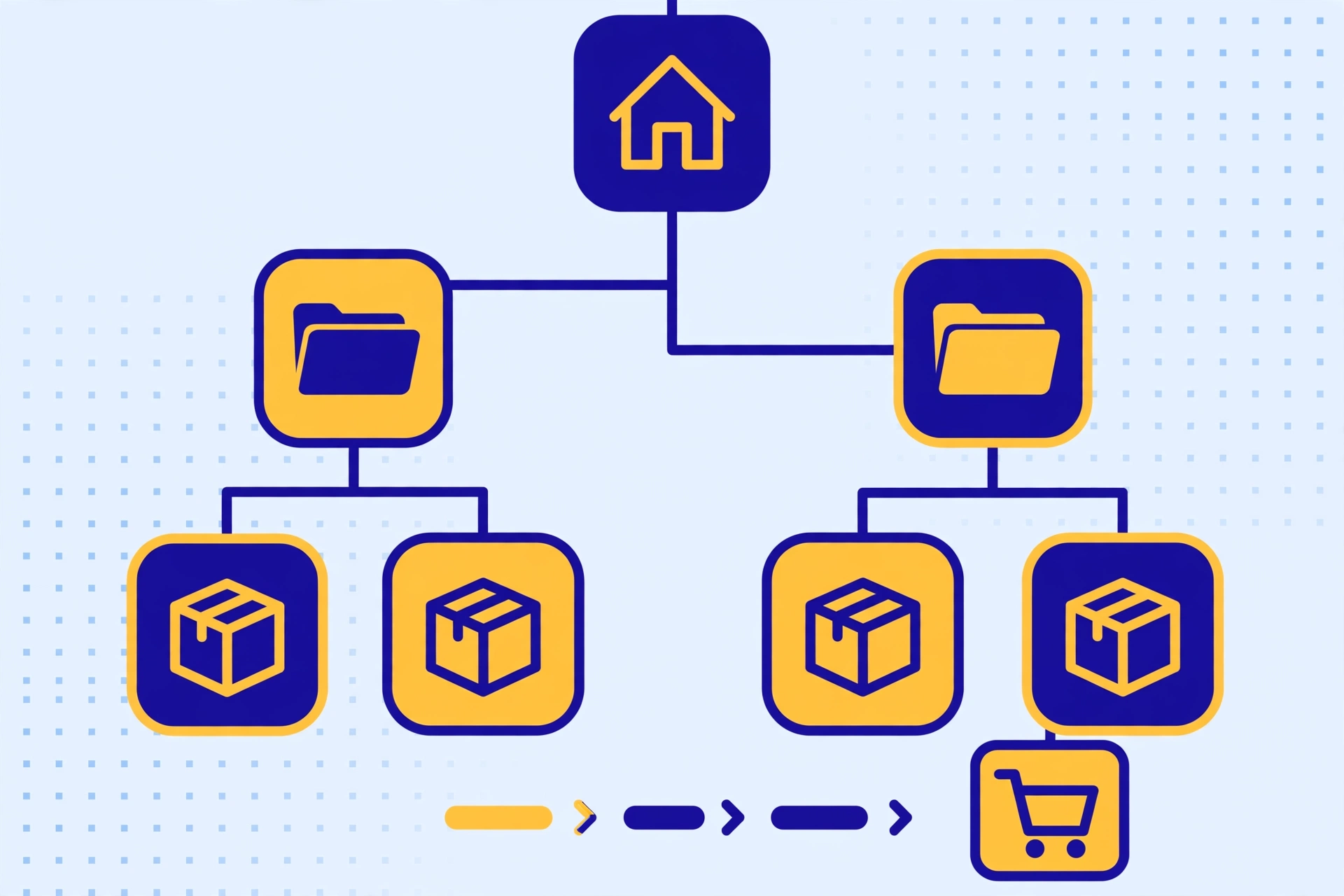
Keep the structure flat: homepage → category → subcategory → product within 3 clicks. Every additional click depth measurably reduces the authority reaching the page. Flat architecture is one of those ecommerce SEO best practices that compounds — every new product inherits it automatically.
- Breadcrumb navigation on every product and category page.
- Internal linking with intent: category pages link to top products, product pages link back up to their category and sideways to related products, and blog content links down to relevant categories.
- Faceted navigation control: noindex or canonicalize filtered URLs (color/size/price combinations).
- Stable URLs: never change a category URL when re-sorting products.
- Crawl budget awareness: on stores with 10,000+ URLs, Google will not crawl everything. Keep important templates within 3 clicks.
Facets deserve special attention because they’re the #1 source of index bloat on stores. The rule: index a filtered URL only if someone searches for that exact combination. “Men’s running shoes” gets searches — index it. “Men’s running shoes, blue, size 10, under $100, sorted by newest” gets zero searches — noindex it. Implement this with a simple policy: one selectable filter = indexable, two or more = noindex, follow. Pair it with AJAX or hash-based filtering where possible so extra combinations never generate crawlable URLs in the first place.
Link equity flows downhill through your architecture, so point it deliberately. Your homepage’s authority should flow to category pages first (your head-term targets), then to hero products. Audit this with a crawl: pages more than 3 clicks from the homepage that drive revenue need more internal links pointing at them — from blog content, from related-product blocks, from the category page itself. Learn how authority moves between pages in our link equity explainer before restructuring.
Product and Category Page SEO Best Practices
This section targets product page SEO best practices directly — plus the category pages most stores neglect, even though categories drive the majority of organic revenue. Get these page-level ecommerce SEO best practices right and the rest of the system gets easier.

Product Pages
- Unique descriptions, always. Never paste manufacturer copy — it is the single most common duplicate-content killer in ecommerce.
- Keyword-fronted titles under 60 characters. Put the product’s core term first, brand and differentiators after.
- Optimized images: compress before upload, use descriptive filenames, and write alt text describing the image content.
- Reviews. Customer reviews are free, fresh, keyword-rich content plus review schema for star ratings. Email every buyer for a review 7–14 days after delivery.
- Product videos. A 60-second demo video increases time on page and gives you a YouTube asset that can rank separately.
- Clear CTAs and related products. Related-product blocks are internal links that also increase dwell time and average order value.
- Canonical tags for variants. Color and size variants should canonicalize to the main product URL.
Write product descriptions for the objections, not the features. Shoppers at the product page already know what the item is — they’re deciding whether to trust you with their money. Answer the three questions every buyer asks silently: will it fit/work for my situation (sizing guides, compatibility lists), what happens if it’s wrong (returns, warranty, stated plainly), and why you instead of Amazon (faster support, expertise, bundles). Descriptions that resolve objections convert; descriptions that list specs get comparison-shopped.
Category Pages
- 300–500 words of unique intro copy. Most stores leave category pages as product grids with zero text. A well-written intro targeting the head term is often the difference between page 2 and page 1.
- Optimized H1 and title. The H1 should match the category’s head keyword naturally.
- Subcategory links. Link down to every subcategory.
- Stable bestseller sorting. Keep URLs unchanged when reordering products.
- Pagination with self-canonicals. Each paginated page should canonicalize to itself.
Structure category copy in three blocks: a 100-word intro above the product grid (the ranking text), buying-guide content below the grid (comparison tables, “how to choose” advice — the content competitors’ thin categories lack), and an FAQ block answering the category’s top questions. This layout keeps the commercial experience clean while giving Google the depth it needs. Update the below-grid content seasonally — a “best espresso machines 2026” section refreshed yearly signals freshness that static grids can’t.
Technical Ecommerce SEO Essentials
- Site speed. Compress images, lazy-load below-the-fold media, and minimize scripts. Measure with PageSpeed Insights on your top 10 revenue pages. Speed work belongs in every ecommerce SEO best practices checklist because it lifts both rankings and conversion rate.
- Mobile UX. Most ecommerce traffic is mobile. Test the full checkout flow on a real phone quarterly.
- HTTPS everywhere. Non-negotiable for stores handling payment data.
- XML sitemap with product/category split. Separate sitemaps for products, categories, and content.
- Robots.txt blocking filtered parameters. Disallow crawling of pure filter combinations (?color=, ?size=, ?sort=).
- Structured data. Implement Product, Review, BreadcrumbList, and Organization schema. Validate with Google’s Rich Results Test.
- Out-of-stock policy. Keep the page live with recommended alternatives rather than 404ing it.
Google’s SEO starter guide covers these fundamentals from the source, and Ahrefs’ ecommerce SEO guide is the best deep-dive on the advanced side.
Prioritize technical fixes by revenue impact, not by severity scores. A broken canonical on your top category page costs more than 500 missing alt tags on dead SKUs. Rank every technical issue by (pages affected × revenue of those pages) and work top-down. Most stores find that three fixes — facet control, canonical cleanup, and speed on the top 20 pages — deliver 80% of the technical gains.
Shopify SEO Best Practices (Platform-Specific)
Shopify handles SEO basics well, but it has platform quirks you must work around. The platform-specific ecommerce SEO best practices below assume you have already covered the general ones above:
- Accept the forced URL structure. Shopify forces /products/ and /collections/ prefixes — you cannot remove them. Optimize the handle after the prefix instead.
- Tame tag URLs. Product tags generate thin duplicate URLs. Do not build navigation on tags.
- Audit your apps ruthlessly. Every Shopify app injects scripts. Review installed apps quarterly and remove anything unused.
- Use URL Redirects for deleted products. Settings → URL Redirects: create a 301 for every deleted product that had traffic or backlinks.
- Set custom titles and descriptions via meta fields. Use the “Search engine listing” preview on every product and collection.
- Theme speed over app features. A fast, lightweight theme does more for your Core Web Vitals than any speed-optimization app.
WooCommerce stores face the opposite trade-off: total control, zero guardrails. The common WooCommerce failures are plugin-bloated page speed, duplicate content from unconfigured product attributes, and no redirect strategy for out-of-stock items. If you run WooCommerce, install one SEO plugin (not three), configure attribute archives to noindex, and set up automatic 301s for deleted products on day one — these three decisions prevent most of the mess.
Content Marketing for Ecommerce SEO
Among ecommerce SEO best practices, content is how a store earns links and captures informational intent:
- Buying guides (“how to choose X”) targeting informational keywords. These are your linkable assets.
- Comparison posts (“X vs Y”) capturing high-intent researchers.
- Internal linking from every guide to relevant category and product pages. Our ecommerce link building overview details how this authority flow works.
One excellent buying guide per quarter beats twelve thin blog posts. Depth earns links; frequency without depth earns nothing.
Make every guide shoppable without being salesy. The formula: genuinely useful advice first, then a “our picks” section linking to your category pages with honest pros/cons — including one product you don’t sell, if that’s the honest answer for some readers. Guides that recommend competitors when appropriate earn more trust (and more links) than catalogs disguised as content. Track assisted conversions, not just last-click: a guide that influences 200 purchases without “converting” any is doing its job.
Ecommerce SEO for AI Search and Video
Two shifts belong in any 2026 ecommerce SEO best practices playbook. First, a growing share of product research now happens inside AI answers — ChatGPT, Perplexity, and Google AI Overviews. The stores that get cited are the ones with clear, structured product information: complete specifications, real review content, comparison tables, and FAQ-style answers on category pages. If an AI system cannot extract a clean answer about your product, you are invisible on that surface.
Second, video is a search surface now, not just a marketing channel. Short product demos and “how to choose” clips rank in Google and YouTube for commercial queries — and embedding them on product and category pages lifts engagement signals too. You do not need a studio: a clear 60-second demo shot on a phone, embedded on the page it describes, beats no video every time.
Common Ecommerce SEO Mistakes
- Letting developers “fix” SEO with plugins alone. No plugin writes unique category copy or designs facet policy. Tools implement decisions; humans make them. Skipping the fundamentals while chasing advanced ecommerce SEO best practices is the most expensive mistake on this list.
- Copying manufacturer descriptions. If 200 stores run the same paragraph, Google ranks the strongest domain and ignores the rest. You’re never the strongest domain on day one.
- Indexing every filter combination. A store with 2,000 products and uncontrolled facets can generate 2 million crawlable URLs. Check your indexed page count in Search Console — if it’s 50x your product count, facets are the leak.
- Changing category URLs during redesigns. Every URL change without a 301 is a ranking reset. Freeze URL structures before redesigns, redirect everything after.
- Treating SEO as a launch task. Ecommerce SEO is maintenance: quarterly audits, seasonal content refreshes, ongoing review generation. Stores that “did SEO once” decay within a year.
- Ignoring site search data. Your internal search log is a keyword goldmine — real shoppers telling you what they can’t find. Mine it quarterly for new category and content ideas.
Measuring Ecommerce SEO: KPIs That Actually Matter
Rankings are a means, not the goal. The ecommerce SEO best practices above only matter if they move numbers — track these instead:
- Organic revenue and assisted revenue — the only metric that justifies the work. Segment by page template to see whether categories, products, or content drive the money.
- Non-branded organic traffic — branded searches would find you anyway. Growth in non-branded terms proves SEO is creating demand, not capturing it.
- Category page visibility — track your top 20 categories’ average position weekly. Category movement predicts revenue movement.
- Index bloat ratio — indexed pages ÷ real products. Healthy is under 5:1. Rising ratios mean facet or parameter leaks.
- Core Web Vitals on revenue pages — not sitewide averages. Your top 20 pages’ LCP and INP directly affect conversion rates.
- Review velocity — reviews per product per month. Stalling velocity means your post-purchase email flow broke.
Report monthly, act quarterly. Monthly reports catch breakage (traffic drops, index spikes); quarterly reviews drive strategy (which templates to fix, which categories to expand). The stores that win treat SEO reporting like financial reporting — regular, boring, and tied to revenue.
FAQ
How long does ecommerce SEO take?
Expect 3–6 months for meaningful movement on competitive terms, in phases: months 1–2 for technical cleanup and quick wins, months 3–4 for content and link momentum, months 5–6 for compounding gains. That timeline assumes the ecommerce SEO best practices above are actually implemented — audits without execution change nothing.
Should I noindex out-of-stock products?
Usually not. Keep the page live with recommended alternatives — it preserves rankings, backlinks, and a landing spot for shoppers.
Shopify or WooCommerce for SEO?
Both rank well when configured properly. Shopify wins on managed technical basics with less effort; WooCommerce wins on control. Choose based on your team’s technical capacity, not on SEO myths.
How do I fix duplicate product descriptions?
Prioritize by revenue: rewrite descriptions for your top 20% of products first, then work through the rest in batches. Use canonical tags for variant pages in the meantime.
How do I prioritize SEO on a store with 10,000 products?
Work top-down by template, not product by product. Fix category templates first, then product page templates, then faceted navigation rules. One template fix can lift thousands of pages simultaneously.
How many words should a category page have?
300–500 words of unique copy is the practical minimum for competitive head terms — 100 words above the grid for the ranking signal, the rest below the grid as buying-guide content. More helps only if it’s genuinely useful; padding hurts readability without helping rankings.
The Bottom Line
Ecommerce SEO best practices are not a bag of tricks — they are an operating system: flat architecture, disciplined keyword mapping, unique page-level content, technical hygiene, and content that earns links. Stores that run that system consistently compound; stores that chase tactics reset every year. Pick the system.
Done-for-you podcast backlinks
Get your brand on Apple Podcasts, Spotify, Amazon and 25 more trusted platforms — placed by hand, reported link by link.