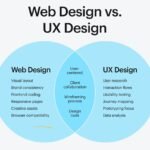

A practical comparison for teams trying to work out whether they need interface strategy, a build partner, or both, written for buyers evaluating vendors.
By the Phenomenon Studio product team
Phenomenon Studio
A product lead comparing quotes will run into two kinds of pitch that sound almost interchangeable and rarely are. One vendor talks about flows, hierarchy, and how a screen should feel to use. The other talks about state management, component libraries, and what happens when five hundred people load the same dashboard at once. Both call themselves design partners. Only one of them is going to be in the room when the product has to work under load.
A user interface design company and a team of web application designers solve adjacent but distinct problems, and the difference matters more than the similar job titles suggest. Confusing the two doesn’t usually kill a project. It tends to show up later, as a rebuild nobody budgeted for once the first version can’t handle real usage.
This piece sets out what separates the two, where the labels overlap in the market, and which criteria predict whether a vendor fits the stage a product is at right now.
What this kind of design partner delivers
A shop selling itself this way typically owns the visual and interaction layer: layout, hierarchy, component states, and a system documented well enough that someone else can build from it without guessing. The best ones test with real users before a single screen ships, and the work product is usually a set of flows, a component library, and a rationale for why each decision was made, not just polished mockups. A weaker one hands over a Figma file with no notes on edge cases, and the gap only shows up once an engineer starts asking questions nobody thought to answer during the design phase.
Where this kind of partner runs into trouble is scale. A user interface design company that has only ever designed static marketing pages will underestimate how much a dashboard with live data, permission states, and error handling needs. Ask for examples of interfaces that had to hold up under real, messy data, not curated demo content, before assuming the skill transfers.
What this kind of partner does differently
Web application designers work inside the constraints of a running system rather than a static page. They design for loading states, partial failures, and screens that change shape depending on what a user has permission to see. The distinction sounds academic until a product hits its first outage, and the interface either degrades gracefully or leaves users staring at a blank panel with no explanation.
Good ones sit close to engineering for a reason. A component that looks fine in Figma can behave badly once real data populates it, and catching that requires someone who understands both the visual system and what the underlying application is doing. Teams that keep these two functions fully separate tend to discover the gap only after launch, when a redesign has to account for edge cases nobody mocked up. A partner who has spent years shipping marketing sites will approach that problem differently than one who has spent years inside a product’s actual codebase, even if both call the deliverable an interface.
Clutch connects service providers with more than 1.4 million monthly buyers worldwide, and reviewer verification, not self-reported portfolios, is central to how the platform ranks agencies. (Clutch.co, 2025)
Why the same job title means different things
Search for either kind of partner and the category labels blur fast. One outfit calls itself a web design agency and only touches static pages. A second insists it offers web development services exclusively, treating design as somebody else’s job entirely. A third markets a broad visual refresh package, and its case studies look almost identical to a fourth calling itself a website development agency. A fifth sells general ui ux design services and covers both functions passably without excelling at either, which is worth probing directly rather than assuming from the homepage copy. None of these labels are dishonest by themselves. They just don’t tell a buyer who does the work.
The pattern repeats on the mobile and application side. A mobile app development company might build the whole product end to end. A shop next door offering mobile app development services might only touch the parts that talk to a server, leaving screens and flows to a separate contractor nobody mentions on the sales call. A narrower ux design agency handling only research and flows can be exactly the right fit when the rest of the scope already has an owner elsewhere. A website development company that only builds, not designs, fits the same way. The problem isn’t a narrow scope. It’s an undisclosed one, especially once web app development enters the picture and the build side needs to match decisions the design side already made.
A related confusion shows up whenever a full-service shop pitches both disciplines under one retainer. Some run design and engineering as one integrated team from day one. Others simply relabel a subcontractor relationship, with a separate ux design agency doing the interface work off to the side and a second, unnamed shop handling the actual build. Asking who sits in the same daily standup, not who appears on the proposal cover page, is usually the fastest way to find out which version you are looking at.
Common mistakes when choosing between the two
- Hiring a design-only partner for a product that already needs application-level engineering judgment, then discovering the gap after the first data-heavy screen ships.
- Assuming a vendor’s homepage language tells you who staffs the actual work, rather than asking directly.
- Skipping a short paid discovery phase and locking a fixed scope before either side understands the real complexity.
- Treating a visual identity studio and an interface partner as interchangeable, when a style guide and a working component system solve different problems.
Interface strategy vs. application build, side by side
| Partner type | Fits best | Watch for |
| User interface design company | Establishing flows, visual system, and interaction patterns before or alongside a build | Limited experience with live, data-heavy interfaces under real load |
| Web application designers | Products where interface decisions depend on system state, permissions, or data behavior | Weaker on brand and marketing-facing design outside the app itself |
| Full-service partner covering both | Teams that want one point of accountability across design and build | Confirm mid-level staff, not only seniors, do the work |
Full-service partners in that last row often publish a sample scope directly on their own site, worth reviewing before a first call: https://phenomenonstudio.com/service/web-app-design/.
Why the distinction shows up on the budget
The gap between the right and wrong hire rarely stays contained to the screen. Products where design and engineering work from the same decisions, instead of handing off a static file over the wall, tend to spend less time rebuilding after launch.
Companies that scored in the top quartile of the McKinsey Design Index saw 32 percent higher revenue growth and 56 percent higher total returns to shareholders than their industry peers over a five-year period, based on a study of 300 public companies across medical technology, consumer goods, and retail banking. (McKinsey & Company, 2018)
Oleksandr Kostiuchenko, marketing manager at Phenomenon Studio, has flagged a pattern that comes up often on early intake calls. Teams that hire a user interface design company for the flows, then separately bring in a team to make those flows work against a real system, often lose weeks re-explaining decisions the first group already made. His read is that the handoff between the two roles, not the choice of which one to hire first, is where budgets usually slip.
What separates a reliable vendor from a risky one
Ask what they shipped under real conditions
A strong candidate can point to live products handling real data, not only a curated set of final screens. Ask what the interface looked like on a bad day, when an API was slow or a permission check failed, and ask how that got handled.
Match the scope to what the product needs
A team offering broad web design services can be exactly right for a marketing site and entirely wrong for a product with real application logic behind it. If the work needs both visual judgment and system-level thinking, look for a partner whose web development agency track record includes shipped products, not just pages, under its own name. A web development agency that has only ever built content sites will bring different instincts than one that has shipped interactive tools.
Check staffing before signing
Ask any shortlisted website development agency whether the people pitching the work are the people who will build it. Senior staff running the sales call, then handing execution to a different team entirely, is one of the more common complaints founders raise once an engagement is already underway. The same question applies to a mobile app development agency handling a native build alongside the web product.
How the work gets divided on a real engagement
On a well-run engagement, the split between the two functions is explicit from the kickoff call. A design lead owns the flows and the component system. An engineering lead owns how those components hold up once real data, real permissions, and real network conditions enter the picture. Weekly syncs exist specifically to catch the moments where a visual decision quietly assumes something the system can’t guarantee, like a list that never loads more than twenty items when production data regularly returns two hundred.
On a poorly run one, the two functions barely talk until a handoff meeting near the end, and the design file arrives at engineering as a finished artifact rather than a starting point for discussion. A web development agency structured around this second model will often quote a lower price up front, since coordination overhead has been designed out of the process rather than budgeted into it. That overhead doesn’t disappear. It shows up later as rework, usually after the client has already signed off on a design that looked complete but never accounted for how the underlying system behaves.
A website development company that staffs both functions from the same internal team, rather than assembling contractors project by project, tends to catch these mismatches earlier. The same people sit through both the design reviews and the engineering standups. That continuity is worth asking about directly: who was in the room for both halves of the last project this vendor shipped, and are those same people available for this one. A mobile app development agency answering that question with specific names, rather than a general assurance about process, is usually the more reliable signal.
What changes depending on the product
A marketing site refresh rarely needs application-level design judgment. A generalist offering website design services, paired with branding companies for the visual identity, usually covers it well.
A product with real application logic, a dashboard, a booking flow, anything with state that changes based on user actions, needs someone fluent in how interfaces behave under real conditions, not just how they look in a static file. That’s where web app development and interface design have to move together rather than in sequence.
A hybrid product, a marketing site attached to a working application, often needs both functions represented, whether that’s one team covering both or two vendors with a clearly defined handoff. Ask directly how the transition between the two gets documented before signing either contract.
Tells that a pitch is polish, not substance
A few patterns repeat across weak engagements regardless of which type of partner is pitching. The proposal leads with polished final shots instead of any explanation of how those shots came about. Nobody on the call can describe how they would measure whether the work moved a number that matters to the business. Timeline estimates don’t shift even after the scope changes twice during discovery, which usually means the estimate was never tied to real scope in the first place.
Any single signal on its own rarely disqualifies a vendor. Two or more showing up in the same pitch is worth a pause before signing anything. A quieter signal is worth watching too: how a team responds when a scope question doesn’t have a clean answer yet. One that pushes back with a thoughtful set of tradeoffs is usually more reliable under pressure than one that agrees to everything on the call and sorts out the details later, once the contract is already signed.
What the contract needs to say about ownership
Ownership of the finished files needs to sit in writing, not in an assumption carried over from the pitch. Confirm that design assets, source code, and any custom components transfer to you outright once payment clears, rather than staying licensed to the vendor. Most agreements handle this correctly, but the actual clause is worth reading line by line rather than taking the sales deck’s word for it.
Exit terms matter just as much as ownership terms. If walking away mid-project is slow or costly, even when the vendor is the one underperforming, the client loses negotiating leverage before the engagement even starts. Look for a termination clause with a short notice window and a defined handoff obligation, since that structure protects both sides rather than locking one in.
Ask who can actually see the working files while the project is underway, not just at final handoff. A vendor that locks every draft inside its own tooling until the last mile makes it harder to catch a bad direction while it’s still cheap to fix, and harder to pull the project in-house if the relationship ends before the work does.
How long this should realistically take
Push for a range instead of a single confident number. Research, interface design, and a first working release together typically take eight to sixteen weeks, with the spread driven by scope complexity and how many people need to sign off along the way. A quote that lands well under that range is usually cutting a corner somewhere, most often real-data testing, and that corner tends to reappear as rework after launch.
A brief paid discovery stage, two to three weeks, lets both sides confirm what’s actually being built before a fixed scope gets locked in. That’s a fair request regardless of who’s across the table, whether it’s a design-only shop, a mobile app development company running the full build, or a hybrid of the two.
What belongs in a serious proposal
- A named point of contact who sits in weekly working sessions, not just kickoff and delivery
- A documented handoff format the team has used before, not one invented for this pitch
- A clear answer for what happens if the product’s direction changes mid-engagement
- A realistic timeline range tied to the actual scope, not a round number picked to win the pitch
A proposal missing more than one of these items isn’t necessarily a dealbreaker, but it’s a reason to ask follow-up questions before signing. Smaller shops sometimes run these processes informally instead of documenting them, which is fine as long as they can walk you through it clearly the moment you ask.
What to confirm with a vendor before signing
- Can we see an interface you designed that had to handle a real failure state, not just the happy path?
- If this partner offers both design and mobile app development services, are both staffed in-house or is one subcontracted?
- Who owns the component library and source files once the engagement ends?
- What’s the process if our web app development needs shift once real usage data comes in?
- How do design and engineering stay aligned once the project moves past the first release?
None of this replaces direct reference calls with a vendor’s past clients. Walking in with explicit criteria, instead of judging similar-sounding homepages against each other, is what separates a good hire from a costly detour through a second vendor a few months in.
Keep the list short enough that it gets used during a real evaluation. Five or six criteria, applied consistently across every proposal, tend to surface the tradeoffs that matter before a contract is signed rather than three months into the engagement.
Frequently asked questions
Is a user interface design company the same as web application designers?
No. One focuses on visual and interaction design, often for static or lightly interactive screens. The other designs for how an interface behaves against a live, changing system. Some vendors do both well, but the skill sets aren’t automatically the same.
Do we need both a design partner and application designers?
Often, yes, whether that’s one team covering both functions or two vendors with a documented handoff. A product with real application logic behind it rarely does well with interface decisions made in isolation from how the system behaves.
How do we tell if a vendor only does static design work?
Ask for examples involving live data, permission states, or error handling, not just polished final screens. A portfolio full of marketing pages and no application interfaces is a useful signal on its own.
What red flags suggest a mismatch between vendor and project?
The three that show up most often: evasive answers about who actually handles the engineering, no examples of interfaces tested under real conditions, and hesitation to hand over direct reference contacts.
Should branding happen before interface design starts?
In parallel is ideal, or at least shortly before interface work starts. Bolting a brand system onto a product that’s already built usually forces a redo of the screens themselves, not just a color and logo refresh.
How do we compare two proposals that scope the same product differently?
Line up the scopes before you look at price. Break out what each proposal actually includes, then compare cost per deliverable instead of the number at the bottom of the page.
Is a smaller team ever the better choice for this kind of work?
Frequently, especially for a single product with one clear owner. A smaller team means fewer internal handoffs, which often moves faster than a larger shop where the person selling the work isn’t the one executing it.
What’s a reasonable discovery phase before committing to a fixed scope?
Two to three weeks is the norm. That’s generally enough runway to test assumptions about users and technical constraints before real budget goes toward a scope that hasn’t been validated yet.